Saturday, 14 March 2015

How are you spelting that?

Today's Bread of Heron baking was all about spelt. What better way to start the Heron Corn Mill's community bread group off than by baking with this increasingly popular grain?

There were seven of us in the hut today, Friday March 13th 2015.


We baked with our boots on, and we baked with spelt. But we left the horses outside.

With seven pairs of hands...


...it is probably no surprise that we got a wide variety of results. After all, each of us was encountering at least something new - the hut, the oven, the flour, the company even! Nice then to find that we all managed to produce very satisfying and good looking results. The bread's not bad either!


Nell had arranged for several different types of spelt flour to be available, and some of us baked with wholemeal spelt, some with white and some with a mixture. Other than that, we were basically following the same recipe, with the same quantities.

Mind you, we Brits are free spirits. Rules are made in Bananistan, and are only there to be bent.


We all started out with a measured 12 fl oz of water and 500 g of flour, an uneasy combination of Imperial and European.


One member of the old school (you know who you are!) went imperial, turning 500 g into 454 g - sorry, 1 lb. And in the spirit of seeing how it went, several water jugs were only partially emptied into mixing bowls.

The conversation got round to recipes and cooks. Delia may be reliable, but safe is so yesterday. Jamie also has peaked, apparently. Paul "Bollywood" was on the steel worktop in the hut, but should he be on the coffee table? Elizabeth David was a trusted name for some - but were we following any of these people? No - we were working with the booklet from the Traditional Corn Millers Guild and to be honest we weren't following it so very slavishly at that.

It was actually very interesting to see how much the consistency of our doughs varied, although we started with much the same ingredients - flour, salt, fresh yeast bubbling away in a little of our water.

I agree with Andrew Whitley's maxim that "wetter is better".


It may sound like Mrs Thatcher's motto when choosing a cabinet, but it works with bread too. That is after all Kenneth Baker standing behind Maggie, and Nigella's dad sitting on her left, so hers was a bit of a kitchen cabinet.

I don't think there can be any doubt that a softer dough takes less work to develop, but maybe a firmer dough is just better suited to a more physical kneading method. Some people soften their dough up Enery Cooper style...


... a couple of left dough hooks, a straight right in the punch bowl and a good splash of Brut 33 to finish. Others ask "how would Jeeves go about it?".


Gentle reasoning with your dough, turning it over, coming at it from a different angle, maybe discussing Spinoza with it over a glass of port in the pantry. Dough needs to feel stretched, after all.

As always, there is no right and there is no wrong way. Bread seems to be unique in forgiving virtually every kind of affront the hapless baker can throw at it. Admittedly we didn't let ourselves go to the extent that this Spanish community bread group ("Pan de la Garza") did when they made pizzas recently -


But within the limits imposed by British etiquette -


we must between us have tried most things on our bread today - bashing, slapping, squeezing, squelching, throwing water at it, throwing flour at it. And it all came out looking absolutely fine in the end. Let's face it - making bread is a piece of cake.


The white spelt loaves came out surprisingly yellow, and noticeably sweet. The wholemeal was nice and brown without being heavy at all. The mixed white and wholemeal was predictably paler than the straight wholemeal, but no less flavoursome. They all stood up to being cut open while still warm - a sacrificial offering to the massed ranks of 7 bakers. And they all ate well, with no butter or with a week's butter ration on a slice.

It was great to find that several people were actively trying out using less salt than the recipe suggested. This has to be a healthy development!

No bread blog is complete without a shot of the bread in question. So I thought I'd do a still life, with some kitchen essentials hovering in the background -


I was quite pleased with that - look at that open texture, and that all-over sunburnt crust! But my dear wife felt there were too many product placements in this. I think it was really the Marmite that upset her. She suggested a more austere approach -


This is too political for me! Eventually she softened a little, and allowed the controversial sour dough from last week to creep into the background -


Whichever way you like your spelt, this is a flour that will repay a bit of love and attention.

You probably realise by now that I am a fan of  James Joyce -
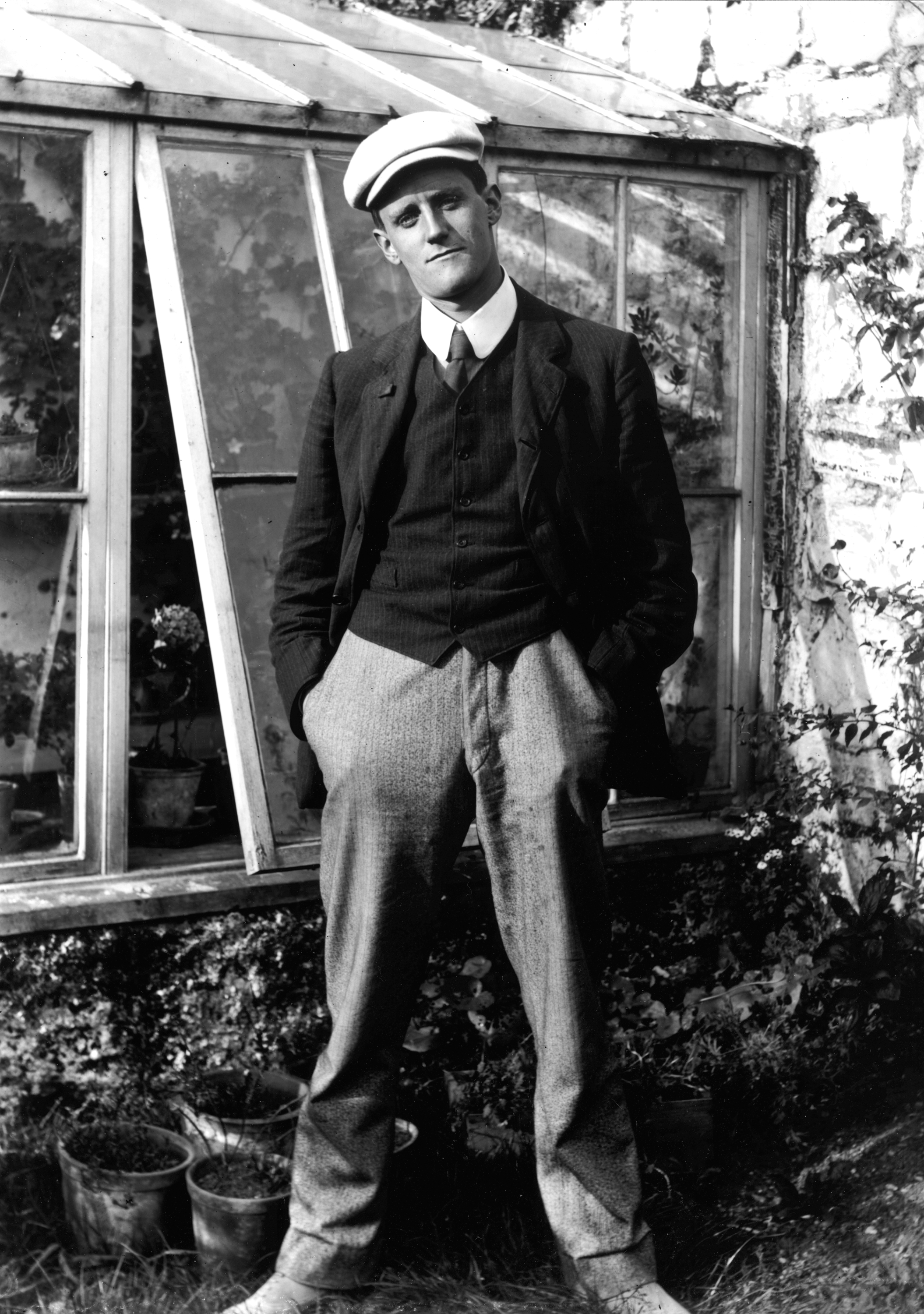

Someone asked him what he was thinking when this picture was taken, and he said

"I wonder if I could touch the photographer for ten bob?".

Here's a bread related puzzle for you, from chapter 16 of Ulysses-

"Tell me where is fancy bread? At Rourke's the baker's it is said."

Answer next time.

Tuesday, 10 March 2015

Bread of Heron


Spring is sprung at Heron Corn Mill's shepherd's hut


At last it is starting to feel like the year is moving on. The snowdrops have been and gone, the daffs are out, and Bread of Heron, the Heron Corn Mill's community bread group, is open for business. You can tell we mean business, because there is a row of Bread of Heron pinnies on the hooks behind the door in the shepherd's hut.


Friday 6th March was the official first meeting of the group. The whole group got together at the barn over a cuppa, to catch up on how everyone was and on developments  at the mill.

Nell had set up a surprisingly challenging quiz, where we tried (often in vain) to put the right name labels next to various flour samples.


Fortunately the Heron Corn Mill sample was very easy to spot, because of the gorgeous rustic bran speckles running through the flour. While all wholemeal flour has plenty of bran, stone ground flour tends to have the bran pieces less bashed about than industrially milled flour. This, I think, is really important for a hearty loaf: it's part of what makes stone ground flour "the real thing".

Among the other samples, polenta was fairly easy to spot because its yellow colour shows it is made from maize. I confidently identified it as "semolina" which was a bit of a stumper, as semolina is made from wheat! I was rather amazed (no pun intended) to find that I have been using the terms polenta and semolina interchangeably for years, because I use them both to stop my bread sticking to the peel on the way into the oven. Incidentally they can both be used to make a thick porridge which is delicious when allowed to cool, sliced into fingers and fried in olive oil until golden brown.

Samples like "coconut flour" had us all stumped. Stuart the miller tried smelling it, but then everything smelled of coconut, so that didn't work. And "buckwheat flour" was a surprise: I occasionally add boiled whole buckwheat to my bread, but according to Stuart farmers get very unhappy if there is any buckwheat in among their wheat. Can't see what all the fuss is about myself!

The other part of the quiz was to match up the names and pictures of 6 types of grain. That is a lot trickier than it sounds. See how you get on with these three grains -


(Left to right - barley, wheat and oats.)

During the morning, people dropped in to have a look round the shepherd's hut, where my bread and Nell's Chelsea buns were being cooked, so it was nice and cosy in there. Yours truly in the shepherd's hut with a controversial white loaf -


Why controversial? I had decided to beef up my sourdough with some yeast. Is this sacrilege, or just pain de campagne? You decide - could make for an interesting discussion at the Bread of Heron!

Everybody who came to look seemed to be really impressed with the shepherd's hut. More than one person said they could quite fancy being a shepherd, if this was the kind of accommodation that went with the job. It really is a nice place to make bread in, that's for sure. Starting next week, the bread group will be baking together in there, so it will be buzzing.

As it was the first Friday of the month, Stuart did a milling demonstration at 11:30 complete with smog mask and hi-tech flour bucket -


with help from regular volunteers Karen and Iain, who like me has a built-in smog mask -


The bread we had for lunch was all started the night before, 25% of the flour being mixed with half the water, no salt and either yeast or sough dough culture.

 
Heron wheat
Dove's spelt
Allinson's white sourdough

Next morning, I added plenty of extras for interest, and to improve the texture - cracked grain, flakes, wheat germ, linseeds. Each of these bowls contain all the additions mixed up for one batch of dough -


It's a surprising amount of stuff to add to a couple of loaves worth of dough, but the bread can take it.

After kneading, the dough was left to rise while I snatched some tea and crumpets -


After breakfast, everything was piled in the back of the car and taken to Heron Corn Mill.

At the mill, the dough was given a bit more time in the mixing bowls to get over the trauma of the drive, and to finish rising in peace.


Once it was fully risen, I shaped the loaves in my usual rough and ready way, and transferred them to the Bread of Heron bannetons - really nice cane proving baskets. I also started off a couple of extra loaves from scratch, and left them to rise in some ice cream boxes - just in case we had any really hungry people for lunch. 


When the bread came out of the oven, I was really glad I'd decided to use different slashes for each kind of bread, and to draw a picture of what I'd done! These two are the extras. You'd never know they were raised in ice cream boxes!


Referring to my slashing diagram, and going from left to right, I can confidently say that these three are white sourdough, spelt and spelt respectively -


On the day, some of the crusts were found to be a bit on the crunchy side for some tastes, but that's the price you pay for serving up warm bread, I suppose. Molly Bloom in Ulysses for one preferred yesterday's bread, as her husband recalled when he nipped out to the butcher's before breakfast - 

"Boland's breadvan delivering with trays our daily but she prefers yesterday's loaves turnovers crisp crowns hot. Makes you feel young."

I couldn't agree more with that last bit. Here's hoping Bread of Heron will keep us all feeling young for a long time to come!

Saturday, 17 January 2015

Salt, yeast and aesthetics

Wake up and smell the bread 

Two people I used to work with had a significant coffee habit. Every morning, while their PCs were warming up, they used to huddle round a steaming coffee pot. We're talking proper strong coffee here, measured in tablespoons, not teaspoons. It takes time and practice to build up this level of caffeine tolerance. Not my scene: Angie and I average 5g of real coffee a week between us!

Salt

There's a parallel with salt, I think. We are so accustomed to the taste of salt behind virtually everything we eat that over time we need more to get the same hit in the taste buds. Simon at Staff of Life bakery in Kendal says he likes to use less salt because if you are not careful you finish up with bread which is really just "flour suspended in a wash of salty water", or words to that effect. When he was baking in France he was accused of using too little salt. His answer was that he could taste that the French bakers were using too much salt, and it was their problem if they could not taste that he was using enough.

Far be it from me to claim that I have superior taste buds. Angie says mine are "shot to bits". When Nell at the Heron Corn Mill gave me a sample of soup to taste, confidently expecting me to identify "burnt", I came up equally confidently with "tahini". My excuse is that salt is everywhere: it's a fact of life.

I started to worry about salt when I realised that quite a lot of Italian bread uses no salt at all, and I wasn't getting any taste out of it. Programmes like Master Chef don't help: time and again people are criticised for "not seasoning properly" which is code for "not putting enough salt in".

Rule of thumb for salt

Hugh Fearnley-Whittingstall's bread book gives the following rule of thumb for salt (page 39) -

FlourSaltRatio of salt to flour
100g2g2%

When I make a batch of 2 loaves, I use 10g salt for 900g flour - approximately 1.1% salt. I thought I'd better check what other people suggest for salt in their bread recipes.

Paul Hollywood uses exactly the recommended amount of salt - 2%.

Ingredients


The great Lionel Poilane, king of sourdough, goes higher (admittedly for a brioche). He uses 2.35% salt - but whatever he does is right: he is the master.

1.1 lbs wheat flour
0.11 lbs granulated sugar
0.42 oz. kosher salt
0.53 oz. fresh yeast or 0.26 dry yeast
5 eggs
7 oz. room temperature butter
7-8 branches of fresh mint
3-4 small brioche pans (optional)


Nigella is the least flamboyant of the bunch - at least as far as salt goes. I'm taking "½ tablespoon" to mean 1.5 teaspoons, or 7.5g of salt. That means Nigella is using a modest 1.25% salt.


approx. 600 grams plain flour
3 teaspoons rapid rise yeast or bread machine or other instant yeast
½ tablespoon salt
1 tablespoon caster sugar
375 ml milk
25 grams butter


    Yeast


    I use the same amount of dried yeast as salt - 10g for 900g flour to make 2 loaves, or 1.1% yeast.

    Hugh's book gives the following suggestion for yeast -

    FlourYeast (dried)Ratio of yeast to flour
    100g1g1%

    So whereas my 1.1% salt is quite low, my 1.1% yeast is slightly over the recommended amount. Some recipes suggest using much more yeast, so this is not set in stone.

    Jamie uses a pukka 2.1% yeast -


  • 1kg strong flour
  • 625 ml tepid water
  • 30 g fresh yeast, or 3 x 7g sachets dried yeast
  • 2 tablespoons sugar
  • 1 level tablespoon fine sea salt
  • flour, for dusting


  • Paul Hollywood sloshes it around at 2.4% yeast -


    500g/1lb 1oz strong white bread flour, and a little extra flour for finishing
    • 40g/1½oz soft butter
    • 12g/2 sachets fast-action dried yeast
    • 2 tsp salt
    • about 300ml/10¾fl oz tepid water 
    • a little olive or sunflower oil


    Nigella has twice as much yeast as salt in her recipe: she uses 2.5% yeast -


    approx. 600 grams plain flour

    3 teaspoons rapid rise yeast or bread machine or other instant yeast
    ½ tablespoon salt
    1 tablespoon caster sugar
    375 ml milk
    25 grams butter


    I generally allow my dough about an hour to rise in the mixing bowl followed by an hour to rise in the tin or proving basket. But that is not set in stone. Nell's bread went in the oven after an hour rising in the mixing bowl and 40 minutes proving in the tin. 20 minutes one way or the other is no big deal when you are making bread, and several things may have contributed to it -

    • the amount of yeast used
    • the temperature of the place where the dough was left to prove
    • the different characteristics of the flour used
    • the effectiveness of the kneading
    At the end of the day, you tend to keep an eye on dough when it's proving, so it finishes up going in the oven when you can see that it is ready. Of course if you're making sourdough, you will probably be waiting for quite a lot longer than if you are using commercial yeast.


    The time to raise a given piece of dough is a function of the amount of yeast used, the temperature and "events, dear boy"


    When it comes to bread making, who's in a hurry? Elizabeth David had it right: use hardly any yeast, and let it rise until it's good and ready. There's always a good book and a glass of wine to be had somewhere.


    Aesthetics


    Would Dame Edna really care what a loaf looks like? Isn't it really just a matter of good taste?

    Programmes like Master Chef would have you believe that presentation is all, or at least non-negotiable.

    It's certainly true that you often get your first impression of food when it is put in front of you. With luck you might get the smell first, if it's coffee or bread for instance.

    And if you've made it yourself you will hopefully have pleasurable anticipation before anything else, because you know what has gone into it both in terms of ingredients and love.

    For me, taste is the only non-negotiable thing. It doesn't matter if it looks rough and ready, so long as it tastes good.

    The way I see it, bread - and food generally - is an everyday thing, and as such it shouldn't need to be proving itself (no pun intended) in a beauty competition every day. You should know it's going to taste good because you have a right to expect it to taste good, because you take the trouble to treat the ingredients with some respect.

    My bread is never going to win any prizes for presentation. I just don't have the skill to do it prettily. And bread is very forgiving. If you let it have a bit of space it will come out looking pretty good whatever kind of a mess you made of handling it.


    I admire the skill that can make bread look like this -

    (Woodbridge Cake Shop)

    But the important thing about a good loaf is that you should be quite confident that it is just going to be "right", whatever it looks like.

    One day I was having trouble deciding which loaf to buy at Staff of Life in Kendal. Simon suggested I take "the next loaf out of the oven" because it "had my name on it" and I was bound to like it anyway. This game of "Russian Baguette" appealed to me and I often remember that Deli Rye loaf with fondness.

    I agree very strongly with Mr Rockard in this favourite old advert from the early 1980s that what's important is for things not to be too chooooooooooey -


    In fact, some of the best tasting loaves around look like this -


    So please, love your bread for how it tastes, not what it looks like. It just wants a bit of loving, and maybe a nice bit of Wensleydale.


    Tuesday, 13 January 2015

    Bread of Heron - high, wide and handsome


    Here we are then: 2015 already and Heron Corn Mill's community bread group "Bread of Heron" still hasn't opened its doors. "So what's been occurring?" as Ness in Gavin and Stacy would say. Why no friendly huddle in the shepherd's hut at the mill every week?

    As any bread maker will tell you, things take time. Setting up a shepherd's hut is no exception: we've been looking forward to the arrival of the Heron Mill shepherd's hut since the summer. But we are getting there at last.

    The Heron Mill shepherd's hut finally arrived mid December 2014. Here it is going on the delivery wagon. There's someone at the front door - nobody at home mate!

    Add caption

    We've got windows on all sides to maximise the light in winter and throw open in the summer.


    The gutter on the front wall is an extra cost option, but we'll appreciate not getting dripped on as we come in and out when it's raining.


    The poor man who delivered it slept in his van overnight, and it was a pretty cold night I can tell you! This is what it looks like on site at the Heron Corn Mill. That's the river directly behind it, and the paper mill beyond. You just have to imagine the grass in front for now.


    The hut arrived with the oven and fittings already in place. But there's still the problem of water. The sink is there, and the taps, but the water that comes through the pipes is so far not up to scratch. The barn is the nearest reliable supply of clean-enough water at the moment. So for now any bread making involves carrying water from the barn to the hut. We could learn something from these ladies -


    Clean water is something it is all too easy to take for granted but you soon notice when there is any kind of a problem with the water supply. The mill has twinned its toilet with a latrine in Khajepur, Bihar, India - something to think about.


    Nell and I weren't going to let a bit of water carrying stop us trying out the new cooker! We took it in turns to fill the Pimm's jug and the washing up bowl in the barn and slop our way across to the shepherd's hut so we could get on with a test bake. We were dying to know what the cooker was like and more importantly what the bread thought about it.

    You need to be comfortable in a kitchen - know where everything is and so on. And it does help if everything is actually there, so we came armed with pencils and paper to make a list of anything we found we were missing. It's amazing how many things finished up on the list! We were aware of course that we would need a table or two for working on, and maybe some chairs for sitting round drinking tea on, in those few precious moments (oh, alright then - hours) between bread  making tasks. Spoons of various sizes, bowls ditto, bread baskets, trays, baking stones, kettle, tea, milk, washing up liquid. Pause for breath. Yeast, semolina, bread boards, loaf slashers. I could go on. 

    Anyway, we decided to be very British about it and plough on regardless. Boldly baking where nobody had baked before, in the middle of a field, by a river, with flour supplies of the greenest credentials, and a little jar of sourdough up our jumpers to keep it warm (love your sourdough, you people). It's a bit like an episode from the Goode Life, I suppose. It certainly has a comic side to it, so it's fortunate that nobody is taking themselves (or each other) too seriously. We're here to have fun - and make some bread!

    Like many things about the Heron Corn Mill, Bread of Heron reminds me of this 1967 description of a sonata by the American composer Charles Ives -


    If you're going to do something, you might as well go in with both feet. Got a mill? Use it! Got a shepherd's hut - well we have now so let's use it. (Just got to get the water and tables in place first though!)

    Nell as usual was thinking ahead and thinking big the day we tried out the oven. She brought along the makings of a couple of pecan nut loaves and a batch of pitta breads. I spent the first couple of hours chatting away, while Nell multitasked - chatting while actually doing some cooking.That's a skill I'll have to work on. Anyway, her pecans were in the oven while my usual bread was still thinking about it.

    The oven is quite a treat after my old banger at home. Fan assisted, and deep enough on the right side to take 3 shelves of bread, 2 shelves in the smaller oven on the left, under the grill. We had a set of Heron bread tins "baking" in the big oven, just to take the newness off them by burning a bit of oil on them. Boy did they smoke! It was like going to the pub before the ban came in.

    Nell opted to slash a fancy diamond pattern across the tops of the pecan loaves. This may have been a bit ambitious, as there were a heck of a lot of nuts to get in the way of the knife. Still, it created a nice rustic effect, complete with nobbly bits. The mix was suitably rich, with butter and molasses as well as what looked like a whole bag of nuts, and the result was really very delicious in a "loaf-o'-cake" sort of way. Marie Antoinette would have been proud of her.

    Next up was the pitta bread sensation. This appeared to be a standard bread mix, but with masses of Nigella seeds added (onion seeds to you and me, but who would miss the chance to call them Nigella seeds?). On a well floured board Nell rolled 'em flat and slapped half onto a hot bread stone and the rest on a baking tray.


    The result was spectacular. They all puffed up nicely like good little pitta breads. But the ones on the stone went up like balloons, much quicker than  the ones on the metal tray.


    This was a good example of "oven leap" and clearly showed what a difference a really hot stone can make.  (When I say "stone" all I mean is a clay roof tile, about 1/2" thick, available from the builder's yard for under a pound.) It takes the best part of an hour to get the stone really hot, so it is great to have 5 shelves available in the oven. You can get on with cooking something else while the stone heats up.

    As you can see above the pittas were really flat when they went in. And when they came out they were completely round like a tin of beans. And they stayed round - none of this shrinking back towards flatness when they cool down, which the supermarket ones rely on - otherwise they would never go in the packet.

    Nell's pittas were rather more chewy and substantial than the supermarket version. The main difference was the freshness, of course. And the spicy Nigella effect. A very nice new experience, and a great wrap for our lunches. 

    My babies eventually made it to the oven when everyone else was ready to head on home. Still, good things come to him who waits, as they say. I was using the end of my Christmas flour from mills near St Albans and Ely, and I had given my sourdough a helping hand by topping it up with half measures of dried yeast. This is a respectable option, I am assured, but I have to say that the end result feels closer to yeasted bread than sourdough.

    Normally sourdough goes all shiny and smooth where you slash the loaf. Yeasted loaves tend to be rough and bubbly where you cut them, with a matt finish. These hybrid loaves definitely would have passed for yeasted.

    Anyway, as Hamlet said of the King's sourdough -

    He was a loaf, take him for all in all,


    We're having another bash at baking in the hut this week, not least to try working at a slightly higher temperature. We used 200 degrees this week, but my bread came out moister than I was expecting, so I'm going in at 240 for 10 minutes and then down to 200, to see if that makes a difference. It's often suggested, to blast first and then turn down. Nell has some people coming round to the mill, so she's preparing a couple of loaves and five fishes.

    Won't be long till Bread of Heron can welcome the first set of plucky bread makers into the sheherd's hut. We're all looking forward to it!