Showing posts with label Bread. Show all posts

Saturday, 14 March 2015

How are you spelting that?

Today's Bread of Heron baking was all about spelt. What better way to start the Heron Corn Mill's community bread group off than by baking with this increasingly popular grain?

There were seven of us in the hut today, Friday March 13th 2015.


We baked with our boots on, and we baked with spelt. But we left the horses outside.

With seven pairs of hands...


...it is probably no surprise that we got a wide variety of results. After all, each of us was encountering at least something new - the hut, the oven, the flour, the company even! Nice then to find that we all managed to produce very satisfying and good looking results. The bread's not bad either!


Nell had arranged for several different types of spelt flour to be available, and some of us baked with wholemeal spelt, some with white and some with a mixture. Other than that, we were basically following the same recipe, with the same quantities.

Mind you, we Brits are free spirits. Rules are made in Bananistan, and are only there to be bent.


We all started out with a measured 12 fl oz of water and 500 g of flour, an uneasy combination of Imperial and European.


One member of the old school (you know who you are!) went imperial, turning 500 g into 454 g - sorry, 1 lb. And in the spirit of seeing how it went, several water jugs were only partially emptied into mixing bowls.

The conversation got round to recipes and cooks. Delia may be reliable, but safe is so yesterday. Jamie also has peaked, apparently. Paul "Bollywood" was on the steel worktop in the hut, but should he be on the coffee table? Elizabeth David was a trusted name for some - but were we following any of these people? No - we were working with the booklet from the Traditional Corn Millers Guild and to be honest we weren't following it so very slavishly at that.

It was actually very interesting to see how much the consistency of our doughs varied, although we started with much the same ingredients - flour, salt, fresh yeast bubbling away in a little of our water.

I agree with Andrew Whitley's maxim that "wetter is better".


It may sound like Mrs Thatcher's motto when choosing a cabinet, but it works with bread too. That is after all Kenneth Baker standing behind Maggie, and Nigella's dad sitting on her left, so hers was a bit of a kitchen cabinet.

I don't think there can be any doubt that a softer dough takes less work to develop, but maybe a firmer dough is just better suited to a more physical kneading method. Some people soften their dough up Enery Cooper style...


... a couple of left dough hooks, a straight right in the punch bowl and a good splash of Brut 33 to finish. Others ask "how would Jeeves go about it?".


Gentle reasoning with your dough, turning it over, coming at it from a different angle, maybe discussing Spinoza with it over a glass of port in the pantry. Dough needs to feel stretched, after all.

As always, there is no right and there is no wrong way. Bread seems to be unique in forgiving virtually every kind of affront the hapless baker can throw at it. Admittedly we didn't let ourselves go to the extent that this Spanish community bread group ("Pan de la Garza") did when they made pizzas recently -


But within the limits imposed by British etiquette -


we must between us have tried most things on our bread today - bashing, slapping, squeezing, squelching, throwing water at it, throwing flour at it. And it all came out looking absolutely fine in the end. Let's face it - making bread is a piece of cake.


The white spelt loaves came out surprisingly yellow, and noticeably sweet. The wholemeal was nice and brown without being heavy at all. The mixed white and wholemeal was predictably paler than the straight wholemeal, but no less flavoursome. They all stood up to being cut open while still warm - a sacrificial offering to the massed ranks of 7 bakers. And they all ate well, with no butter or with a week's butter ration on a slice.

It was great to find that several people were actively trying out using less salt than the recipe suggested. This has to be a healthy development!

No bread blog is complete without a shot of the bread in question. So I thought I'd do a still life, with some kitchen essentials hovering in the background -


I was quite pleased with that - look at that open texture, and that all-over sunburnt crust! But my dear wife felt there were too many product placements in this. I think it was really the Marmite that upset her. She suggested a more austere approach -


This is too political for me! Eventually she softened a little, and allowed the controversial sour dough from last week to creep into the background -


Whichever way you like your spelt, this is a flour that will repay a bit of love and attention.

You probably realise by now that I am a fan of  James Joyce -
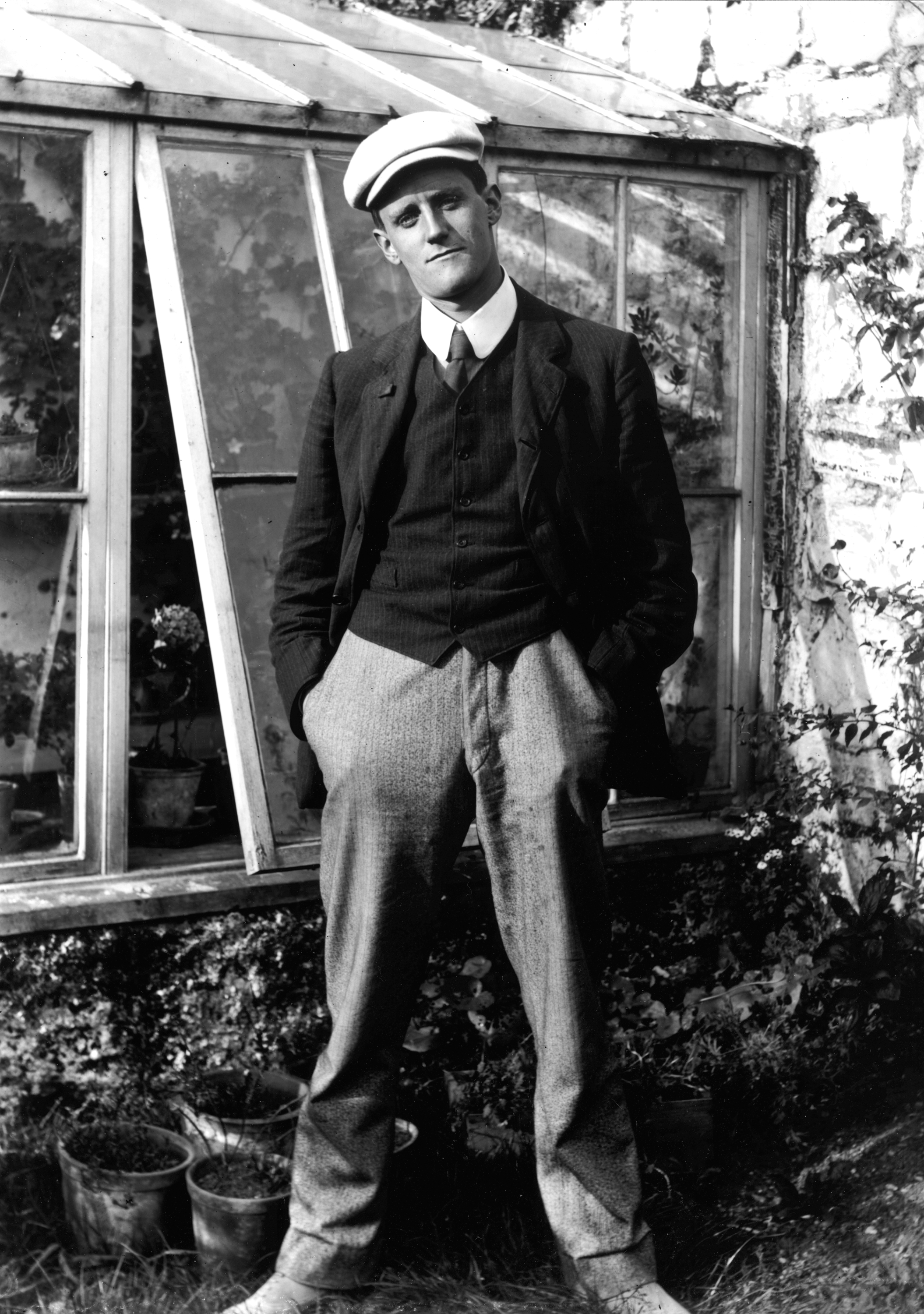

Someone asked him what he was thinking when this picture was taken, and he said

"I wonder if I could touch the photographer for ten bob?".

Here's a bread related puzzle for you, from chapter 16 of Ulysses-

"Tell me where is fancy bread? At Rourke's the baker's it is said."

Answer next time.

Monday, 7 July 2014

Wimbledon bread

While the men were battling it out at Wimbledon, and the sun was shining outside, I was in the kitchen yesterday, baking 2 yeasted and 2 sour dough loaves.


The 2 loaves at the back in the picture are yeasted wholemeal wheat. Three quarters of the flour was milled at the Heron Corn Mill, topped up with a cupful of Carr's because I didn't quite have enough of the delicious gold dust produced at the Heron on the first Friday of the month.

The 2 loaves at the front in the picture are half Salkeld organic white and half Heron wholemeal wheat with a little sourdough culture in place of yeast. The culture is about 12 years old, and I got it from the Staff of Life in Kendal. It's been developing Arnside characteristics in my fridge for about a year now, and is pretty stable. It still needs to be cut back occasionally, but the main thing I do is to put the whole culture into each bake, and make sure to take some out to carry forward to next week at the end of my overnight sponge. Using the whole culture every week ensures that what is in the fridge never gets too acid from lying around for too long.

I started both breads off the night before, with a quarter sponge - a quarter of the flour with half the water, no salt, and either a spoonful of the sourdough culture or half the yeast. This develops extra flavour over night, and ensures you get a vigorous rise the next day, although vigorous is a relative term when it comes to sourdough!

I added the rest of the ingredients to the sourdough about 9 a.m. and left it to its cogitations till about the time the tennis started, so it had about 5 hours rising in the bowl before I got on with the yeasted bread in the afternoon.

The yeasted bread is easy to time - 

  • overnight sponge
  • 10 minute knead
  • 1 hour rising in the bowl
  • 5 minutes to fold and shape
  • 1 hour in the proving basket
  • 50 minutes in the oven
The sourdough continued to rise in the bowl until the yeasted dough was in the first pair of proving baskets at 3.15 p.m. I then moved the sourdough on into the second pair of proving baskets, so it had about 1h 45m for its final proving before reaching the oven about 5 p.m.

You just have to let the sourdough do its own thing until it's ready, so it helps to have other things on the go, like the yeasted bread, or Wimbledon. But it's a sobering thought that I started the bread off about 10 p.m. on Saturday, and took it out of the oven about 6 p.m. on Sunday. So they are not joking at the Handmade Bakery in Slaithwaite when they call their bread "sleepless white". As Elizabeth Botham's in Whitby puts it - some things just take time.

Tuesday, 6 May 2014

Heron Corn Mill bread

Hurray! Flour from my local mill!

By a great stroke of good luck, I chose a great day to call in at the Heron Corn Mill in Beetham to see what "being a volunteer" might look like. The first Friday in the month is when miller Stuart demonstrates milling flour as part of a tour of the workings of the mill.

Stuart and the mill team have put in a lot of hard work renovating the historic mill, with help from Lottery funding. And there is still lots to do, as with any restoration project. But there is also plenty of fun to be had, which is why I went along to see about volunteering.

Stuart sold me a couple of Heron Mill baking tins, and I took home a couple of bags of the flour I saw milled, and this is what I did with them.

First off, I made a quarter sponge. This is the Oxford English Dictionary definition -

4.I.4 To convert (flour or dough) into ‘sponge’. Also intr. 

   1772 Ann. Reg. ii. 109/2 So will a thimble-full of barm, by adding of warm water, raise or spunge any body of flour.    1876 Mid-Yorks. Gloss. 134/2.    1962 M. E. Murie Two in Far North ii. vii. 171 The [bread] sponge didn't sponge in spite of red damask tablecloth and fur parka I had lovingly wrapped it in.

Sponging allows the yeast to do some preparatory work on the flour, developing flavour in advance.I was making two loaves (2 * 450 grams of flour) so a quarter sponge means taking a quarter of the flour (225 grams) and mixing with half the yeast (1 teaspoon) and half the water (1 cup, 9 fluid ounces) - and no salt.


You can see the yeast getting to work on the flour, forming bubbles on the surface of the very moist mixture. Having no salt in there means there is nothing to hold the yeast back, and it really has a great time gorging itself on the flour. All that feasting starts breaking down the flour and generally developing the flavour. If you have never tried this, you should! An overnight sponge makes a real difference to the bread you bake the next day.

By the way, the snazzy plastic bowl can be found at Asda for £1.50 or at the Pound shop in Lancaster for - a pound.

Once the sponge had done its work (several hours), I set about making the bread. As well as adding the rest of the flour, I threw in some extras for added texture. I try lots of different ingredients in this way, but I always measure them quite carefully with the large side of the plastic spoon that came with my bread making machine. That way I know what works and what doesn't. For 2 loaves, these are my usual choices -

  • 4 tablespoons of rye flakes
  • 4 tablespoons of cracked wheat
  • 2 tablespoons of linseed (golden for white bread, the cheaper brown for brown bread)
  • 2 tablespoons of wheatgerm

I use quick action "easy bake" dried yeast (not the old fashioned "dried active" stuff that you need to mix with water, and which doesn't taste nice at all). The quick action stuff can be mixed in with the dry flour and works really well. Simon at Staff of Life bakery in Kendal uses it, so it must be OK. Don't waste money on those little sachets, though - you can get it in a tin made by Dove's Farm or Allinson's for about £1.15 and it lasts for ages. You can also get it from Single Step Wholefoods in Lancaster, where it is even cheaper, and you buy it by the ounce which rather appeals to people of my age!

To get the salt mixed in properly without damaging the yeast, I mix it with the second 9 fluid ounce cup of tepid water. In fact, though, I like to make my bread nice and moist, because it just works better, and with all the extras I used in this bake, I finished up adding nearly 2 cups of water at the mixing stage, making 27 fluid ounces in all. But it's best to start with a fairly dry mix (1 cup of water at sponging time and 1 cup at mixing time) and then keep adding till you think it can't take any more. Then add a bit of olive oil and you get a really smooth and lovely texture. This is the bit I like most about working dough - when it feels really smooth and velvety, you just know it is going to be fine. If you really go too far, you can always add a bit of flour at the end to make it more manageable. But as Andrew Whitley says in his book (Bread Matters) - "wetter is better".

After about 40 minutes rising, my bread was starting to look lively -


But I let it have at least an hour and it was up to the top of the bowl by the time I moved it on into the Heron Mill tins.

Don't listen to anyone who says you need to knock back your dough! Why waste all those good bubbles? It just needs a bit of gentle stretching to get it going strong in the final proving stage. As Simon at Staff of Life said, anything more than half a dozen gentle stretches and you'll knock all the life out of it. I watched the lady at the Handmade Bakery in Slaithwaite near Huddersfield moving bread on into proving baskets, and there really is nothing to it. Their website spookily has a picture of me having a cup of good Yorkshire coffee in the cafe - a chance in a million.

Just cut the dough into 2 loaf sized pieces, and fold in 3, stretching as you go. Then turn it round 90 degrees and fold in three again, stretching as you go. The Handmade Bakery lady then dragged the dough towards her a couple of times, with her hands cupped round the back of the loaf. The bottom sticks to the table, so everything else gets a good stretch. Very hard to explain, but it feels right. Here's a picture from their web site, showing how it's done -


But just the folding is probably enough preparation for putting the bread in the tins. When I've used tins in the past, they have always been coated with a non-stick surface, but the Heron Mill ones are simple heavy grade metal tins. I was fairly liberal with the oil to make sure that they wouldn't stick, but this was not a good idea, because the tins are made from folded not pressed metal, so the corners are actually joins and can leak. As it turned out there was no way they would have stuck, so I would recommend just a very light wipe with an oily piece of kitchen roll.


It's clear from this picture that the bread is going to be substantial and coarsely textured - really good qualities in a wholemeal loaf! I left them for an hour in the warmth of the kitchen - no direct heat, but a leisurely rise, covered with a tea towel against draughts.

They went in the oven on the rack above the middle of the oven, pre heated to absolute full whack, and only turned down to gas mark 8 after about 14 minutes. My usual bake is done on a hot stone, so it's not surprising that these loaves needed 55 minutes rather than my normal 50 minutes. There is the tin to heat up, after all, and no super-heat from the stone. It's always better to be safe than sorry - there is nothing worse than an underdone loaf.


When they came out, you could just see the lettering on the side and end of the loaf, thanks to the tin. And the flavour was completely wonderful - rich and nutty. Maybe I am a bit dewy-eyed about baking with flour I've seen milled at my local mill, but it really is a special taste!


And the texture was good too -


If you want to see flour being milled (in small quantities) at the Heron Corn Mill, why not come along on the first Friday of the month, where Stuart will be doing a mill tour and milling demo at 11:30. The tour costs £5 and is really interesting. A mill tour (with the wheel turning, but no milling) is available at 11:00 every day the mill is open, again the cost of the tour is £5. And you can look round the mill under your own steam for free.

Pete Taylor