Tuesday, 6 October 2015

French bread


As I approach my 60th birthday, and the prospect of a little foreign holiday to celebrate it, I hope you will forgive a little wander down memory lane. Bread is never far away down there, you can be sure!

This is a photo of me as a little tike, the colour almost completely faded after years in the sun. It must date from the early to middle 60s judging by the milk teeth -


I remember that jumper very well. I wore a little metal stud badge pushed through the wool for ages. The badge was in the shape of the number "67" and my auntie Ada brought it back from her travels to Canada, where she visited Expo 67 in Montreal. But the picture was taken earlier than 1967 because there is no badge showing.

That photo has been part of the furniture in my room for ever, so you can imagine that when my daughter saw this next photo on a birthday card, she snapped it up for me on the spot.


This delightful little chap, as well as being a dead ringer for my younger self, is clearly having a great time getting the bread in. And it looks like it really ought to be his birthday too. That baguette has been immortalised at the very peak of its brief existence, bringing a moment of simple, timeless joy to the heart of the little lad. You just know it is crisp, warm, salty and delicious.

Whenever I see really nice bread like that, it starts me off looking for bread pictures, and thinking about the places I've found champion bread in the past. The French connection of that picture set me looking for a picture of the yellow corn and linseed baguettes I had on a cycling holiday one year at Donnery, next to the Canal d'Orléans. I found the baker's shop on Google Maps' Street View, with the canal bridge in the background -


But there doesn't seem to be anything showing the bread unfortunately. This internet thingummy is so disappointing! I did find out that there have been two owners in recent times, Stephane Touche and Christophe Chalon so it would probably be different if I went back now. This is always the big decision - to remember it as it was, or to search it out again and risk being disappointed.

The baguettes here were really, really yellow, like Bouran's biscuits. And this time I'm sure it wasn't turmeric or any spice at all - just the flour, which must have had an injection of the corn that grows everywhere round Orléans.

And by the way, the shop is part of a chain called "Banette" and lists banette as one of the types of bread that it sells. Can you imagine having a bread chain in the UK that people remembered as a quality high spot on their holidays? "Ah, mon dieu - Greggs - c'est parfait". It just isn't going to happen, is it? Even the bigger French chains like "Paul", which I honestly thought was a family bakery when I hit my first one in Aix, can be really good in France. Paul unfortunately suffers by being anglicised, and I wouldn't recommend the one at St Pancras International. 

But what is a banette? I first had one at Chaumont-sur-Loire, but that is another story. Suffice it to say that it is a shorter, broader and more substantial beast than a baguette. Well worth getting to know, I think. And persistence is repaid, because when I looked this up, I found a reference to a "banette o'mais" which is that mixture of wheat and corn that I was talking about at Donnery.

While I was searching for the Donnery bakery, I found this picture of the Maureille bakery at St Jean de Braye, which is on the Orléans side of Donnery. I think you'll agree that there is clearly someone baking there who knows what they are doing.


That's proper sourdough, and more fougasse than you can shake a stick at. And according to one of the customer reviews, they also offer -

"gâteaux pour lesquels les clients forment 1 longue file d'attente sur le trottoir le dimanche matin"

Need I say more?

It's impossible to get started anywhere round the subject of bread without ending up dreaming about sourdough. Nell told me that Aidan Monks warns against using anti-bacterial hand wash round sourdough, and strongly encourages organic flour. I have to admit I haven't stuck rigidly to organic flour. Once the culture is established, I figured it should be able to fend for itself. But really, why wouldn't you give it the benefit of flour that is the truth, the whole truth and nothing but the truth? I will have to pull my socks up on this, I can see. But what about French sourdough?

Poilane


At Bread of Heron we like to keep each other informed about what's going on breadwise, and last week one baker brought in this article about sourdough. The article is fine so far as it goes, but it was a bit naughty to use a picture of the signature Poilane loaf without mentioning the great man in the article.

Poilane is a legend in the sourdough world, and I dragged my long suffering wife to the Paris shop on holiday one year. The shop basically sells sourdough and biscuits. The biscuits are called "punitions" because it is a punishment to have to stop after one. They have a cunning plan to get you to buy more: they keep you in the shop by leaving a basket of punitions on the counter, and then you have to keep buying bread because you want another biscuit. Clever. Very.

Andrew Whitley quotes Poilane in his book "Bread Matters" -


In other words, baking bread together with other people is good for you. That's why we enjoy the Bread of Heron community!

I get occasional mail shots from Poilane, such as this one. If you see this in French, and you use the Chrome browser, you can get Google to translate it for you if you go to Menu | Settings | Advanced | Languages and check "Offer to translate pages that aren't in a language you read". You need never see another foreign language page ever again.

And I can say with confidence that Poilane has managed to stay true to its roots despite setting up in London. The Poilane shop I went to near Sloane Square is very much like the Paris original, and the bread is really good. Although it is quite a lot more expensive in the UK than in France (9 euros 10 cents for a 2 kg loaf in France, and £4.95 a kg if I remember right in the UK), I have only a moment's hesitation in saying it's worth every penny of the asking price.

Friday, 2 October 2015

Sandwiches and staleness


What's in an egg sandwich?


Yesterday, I treated myself to that staple of British fast food, an egg and mayo sandwich from the supermarket.

As I casually munched my way through the rather soggy bread, I wondered what exactly had gone into it. If I'd made it at home, I would have put a small amount of love and a handful of ingredients into it. Something along these lines -


  • flour
  • water
  • yeast
  • salt

  • hard boiled egg

  • raw egg
  • oil

  • butter

I could hardly have been further from the rather worrying truth. The contents of my sandwich were as follows -

  • multiseed bread mix
    • fortified wheat flour
      • wheat flour
      • calcium carbonate
      • iron
      • thiamin
      • niacin
    • sunflower seeds
    • linseeds
    • oats
    • pumpkin seeds
    • rye flour
    • wheat gluten
    • sugar
    • wheat bran
    • burnt sugar
    • salt
    • emulsifiers - E472e
    • soya lecithin - E322
    • wheat flour malted (sic)
    • acid - E300
    • anti-caking agent - E552
    • enzymes
    • lactic acid bacteria
  • water
  • wheat flour
  • wholemeal wheat flour (sic)
  • yeast
  • stabiliser - E415
  • egg mayonnaise filling
    • free range eggs
    • mayonnaise
      • vegetable oil
      • spirit vinegar
      • sugar
      • mustard flour
      • salt
    • salt
    • white pepper
  • vegetable fat spread
    • sunflower oil
    • rapeseed oil
    • partly hydrogenated palm oil
    • water
    • whey powder
    • salt
    • emulsifier - E471
    • acidity regulator - E330
    • preservative - E202
    • flavouring
    • colour - E160a
    • vitamin A
    • vitamin D3


I don't know why they were so worried about the possibility of a bit of eggshell having made its way through to the finished product - there is practically everything else in there except the kitchen sink.

Suffice it to say that I was not impressed - neither by the sandwich nor the list of contents. Why do we need all this rubbish in a simple product like this? Of course, we don't. But while mugs like me keep buying it, the supermarkets will feel they are just giving the customers what they want. Well it isn't what I want, even when it's been reduced to half price to ensure a quick sale!

What constitutes stale bread?


One of our bakers at Bread of Heron, the Heron Corn Mill's community bread group, says that her bread does not keep fresh beyond a couple of days. I'm puzzled by this, because on the rare occasions when my bread lasts that long, it seems well short of stale to me for anything up to a week. As we've been making bread with the same flour, in the same oven, using the same recipe, it can't be that one baker's bread is actually staler than the other's.

It either has to be how the bread is being stored, or just a difference in our taste buds. But what exactly is staleness? The wonderful OED gives a variety of meanings, some of which are quite surprising.

The oldest examples suggest that staleness in drinks used to be a good thing meaning roughly "well aged" -
"Of malt liquor, mead, wine: That has stood long enough to clear; freed from dregs or lees; hence, old and strong."
Chaucer suggests adding nutmeg whatever state the beer happens to be in -

"Notemuge to putte in ale, Whether it be moyste or stale."

So new ale is "musty" or "moist", and more mature ale is "stale". Another example warns that -

"Good ale‥must be‥made of good corne, well sodden, stale and well purged."


The mind begins to boggle. But what is staleness in bread? 


We think of stale bread as being dry and hard. But I think Andrew Whitely says somewhere that staling is more about the bread firming up over time. When a loaf comes out of the oven the inside is generally very soft, and it firms up rapidly as it cools. Maybe the staling process is just the bread continuing to firm up over several days.


Anyway, there are lots of things you can do with stale bread - ask any Italian!


Monday, 28 September 2015

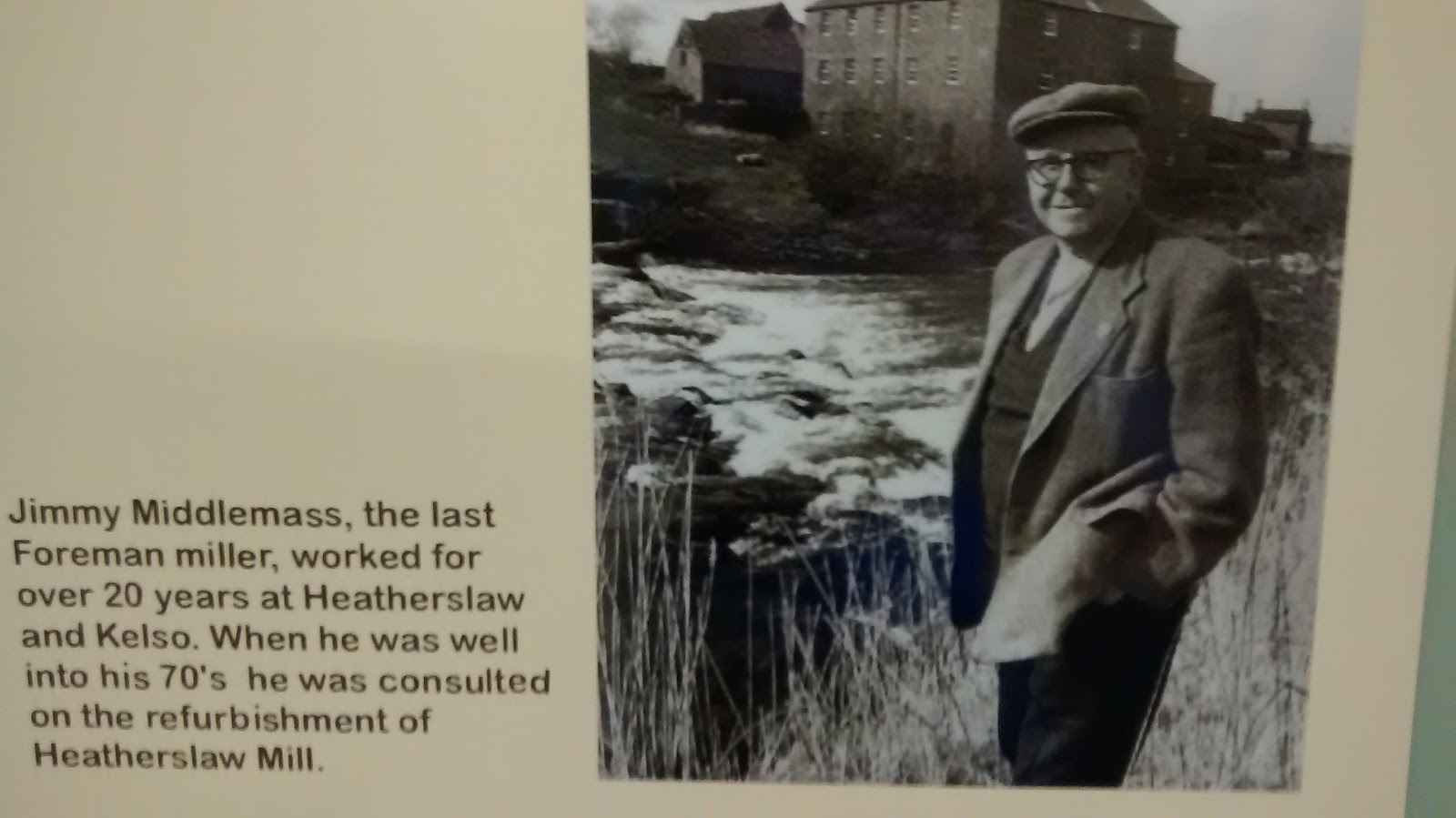
A visit to Heatherslaw Mill

During the summer break from Bread of Heron, the Heron Corn Mill's community bread group, I was starting to suffer from mill-withdrawal symptoms, so when we took a trip to Northumberland, I was on the look out for a mill to visit. We found one about 10 miles south of Berwick-upon-Tweed.

Heatherslaw Mill sits on the river Till at a picturesque spot half way between the villages of Ford and Etal, Both villages show signs of serious historical wealth - like castles.

You can see a bit about the area, including some footage of the mill's waterwheel in action in this short video. Visiting Ford and Etal was a little like stepping into an episode of Midsomer Murders. I kept expecting to bump into a mad vicar on the village green.


The river Till feeds into the river Tweed and runs at a fairly relaxed pace. The mill doesn't have the benefit of a great drop in the height of the river like the Heron Corn Mill has. And unlike the river Bela which has lots of other streams feeding into it, the river Till picks up hardly any extra water on its way. So the mill has to make the most of the water it has, and the power it supplies.


But it may be a mistake to think of the river as a bit of a meandering stream. There are some frightening flood level marks in the ground floor of the mill, dating from 1948 and 1992. And the Mill pamphlet contains this poem -

Tweed said to Till:
'What makes you run so still?'
Till said to Tweed:
'Tho' ye run with speed
and I run slaw,
Yet where you drown ae man
I drown twa'.

Presumably that is where the "slaw" in Heatherslaw comes from - nothing to do with cabbage after all!

The waterwheel at Heatherslaw is undershot, with the bottom of the waterwheel being the only part that makes contact with the flowing water. This is the same arrangement as at Woodbridge Tide Mill. You can see the shape of the flat paddles on the Woodbridge wheel here -


I tried to catch the Heatherslaw wheel, but without much success -


The flat paddles are a sure sign that the wheel is undershot. Wheels other than undershot wheels have buckets rather than paddles. Examples of wheels with buckets -


  • Heron Corn Mill - breastshot wheel (these are the old buckets)

  • Redbournbury Mill - overshot wheel


  • Little Salkeld - pitchback wheel (like a reverse breastshot)


Although an undershot wheel is not efficient way of working, Heatherslaw Mill has 3 pairs of stones, and a barley polisher, all driven by water. The barley polisher runs with the stones in an upright position, unlike the Heron Corn Mill's stones, which lie flat. The idea is not to crush the grains, but to remove the outer cover.


The stones are much smaller and do not have grooves.


In fact the miller has a clock that tells him when the barley has been polished enough. When the bell rings he has to stop polishing the barley. The clock doesn't tell the time, it counts the revolutions of the stones.


A second water wheel was added at Heatherslaw in 1770 and is still in place, although no longer working. When it was fully operational, each of the two wheels was fed by its own mill race.

The miller is a very approachable and chatty lady who is clearly well used to sharing her knowledge about the mill with the public. She told me that the waterwheels were originally external, and the building was later enlarged, enclosing the waterwheels. This sounds like the Heron Corn Mill, where Stuart says the wall on the inside of the waterwheel was originally the outside wall of the building, which was subsequently enlarged.

Much of the mill workings at Heatherslaw can be controlled from the working floor of the mill, like the sluice gate -


Some of the machinery at Heatherslaw is similar to that at the Heron Mill, like this sieve suspended on moving belts -


You can see the central shaft going up from the main gears on the bottom floor to the top of the mill. and the flour to be sieved is coming down into the sieve from the top of the mill.

We have something very similar to this at the Heron Corn Mill -


There has been at least one mill at Heatherslaw since 1300, and a document of 1376 talks about a "new water-mill". Like the Heron Corn Mill, Heatherslaw has long had another mill facing it on the opposite side of the river. About the same time as the second waterwheel was installed in the corn mill, a forge mill was built on the other side of the river, to produce farm implements.

The forge mill is long gone, and in recent times a narrow gauge railway has grown up on the other side of the river. This is very good for the mill, as it brings in lots of visitors who get two attractions for the price of one as it were. We took a very pleasant return trip to Etal village on the train before visiting the mill. At times it felt like the train could hardly make it up the hill, but it got there in the end. The gentle pace gave us plenty of time to take in the delightful countryside, and watch a heron on the river. There is nothing to beat the smell of smoke on a nice summer's day!


This chap seems to have played a role like Bob's at the Heron Corn Mill


We could do with one of these donations boxes - very natty!


At the Heron Corn Mill, one of the most dangerous jobs is disconnecting the stone by putting a horseshoe between the stone nut and the shaft it sits on. This is Stuart lifting the stone nut up so he can put the horseshoe under it -


At Heatherslaw the same effect is achieved with a jack. Much safer!


Heatherslaw Mill processed oats, like Heron Corn Mill, and had a kiln to dry the grain. But the Heatherslaw kiln is much smaller and altogether different from the Heron's. The oats sat over a small fire, and were turned by a rotating blade, driven from above.


We had a nice day when we went to Heatherslaw. One of the best things was that we were able to take some flour home with us. I would recommend it to you if you are visiting Northumberland.


Tuesday, 1 September 2015

On the road at Dent and High Bentham


The Heron Corn Mill's "On the Road" project visited Dent and High Bentham recently. We have taken the mill out to some really nice places throughout the summer and let people all over the local area know what we do and where we are. We provided honest to goodness lunches wherever we went, and had a good chin wag on milling and food topics at every destination. We've also met plenty of interesting people at the six venues along the way - Arnside, Grange, Ingleton, Kirkby Lonsdale, Dent and High Bentham.

Dent


The trip to Dent happened while our Palestinian friend Bouran was still with us, so the baking had an international flavour. First there were a couple of olive sourdoughs -


Look at this blistery crust!


Then there were some very impressive knotted rolls - a sort of distant relation of the croissant. The trick here was to roll the sweet dough out so that it was thinner at the ends than in the middle. That way, tying the thin ends together results in a regular thickness all the way round, as well as holding the shape.


The building we were in at Dent was originally a school - and one of our number is an ex-pupil.


A bit of quality control in the kitchen: miller's perks.


Anxious moments before the lunch time rush.


In the main room the younger generation were getting stuck in.


Swapping some baking tips. But who with?


The youngsters at Dent were really adventurous. We had several takers who were keen to have a go at baking. There was a young lad who was on a secret mission involving delivering something in his wheelbarrow. There were several sightings of him round the village during the day, coming and going. I got the impression there was an interesting story somewhere - maybe he was being a private detective or smashing an international spy network! Anyway, he wasn't too busy to keep coming back to the hall at regular intervals - working his dough, shaping it, putting it in the oven. At the end of the afternoon he proudly took his baking home to his dad, carefully wrapped up as a present. What fun!

Here he is getting a bit of help with shaping.


Then there were the swan makers.


Who would have thought a swan started off circular?

After lunch we had a really interesting talk about spinning. There is a great deal to this, from the three different sets of sheep involved in producing a lamb suitable for the dinner table, to the properties of different wools and the different techniques involved in spinning and using the wool.

What used to be a highly prized natural material has over time become pretty well a waste product, worth less than the cost of shearing. The EU has even designated fleeces as hazardous waste, which surely says more about the EU bureaucracy than it says about wool.

Faced with the problem of what to do with a product that nobody wants to buy, producers have had to find innovative ways of adding value. This has resulted in a number of niche markets like house insulation that can capitalise on the eco-green aspect of natural wool.

There's a lot of skilled work to be done to the wool before it's in a state to spin, and it's not even spinning at all unless you are combining at least three separate strands.

This demo makes it look easy, but the lady who was doing it said that she is doing several things at once, all of which have to be learned and mastered, as well as being very skilfully done at the same time. It all seemed a bit like keeping several plates in the air at once, any of which could bring the whole thing crashing round your ears.


Dent is a really lovely place, and well worth another visit. The church is very old and full of fascinating details, like the family box pews, several with carvings in the woodwork dating back to the early 17th century. Just think - the pulpit (1614) was built 9 years before the First Folio of Shakespeare was printed! And there is a lovely walk by the river. I was unlucky with the brewery tap, which was not serving food the day I went, because of a large party, but at least I have an excuse to go again now.

High Bentham


The very last "On the Road" date was at High Bentham. I toyed with the idea of a £10-30 day return on the train from Arnside. But in the end I drove, which turned out to be a good choice because there are several lovely old villages between High Bentham and Carnforth, which is the route the SatNav took me on the way home.

It was a busy day in High Bentham when we were there. Not only did a lot of people turn out to see us, but there was a Saturday market across the road, and a beer festival, with its own beer bus taking people to any pub along the line. And a day ticket was only £1!

Apparently the recipe for this loaf said "tie a knot in it". A slip knot maybe. I think it looks like an ampersand, but other opinions were expressed.


Nell produced a superb pecan loaf (at the back) and a Heron spelt (at the front).


We had a demonstration of the reverse-Bertinet kneading method, with pike. Don't try this at home.


Funny how there always seems to be a crowd round the cake counter.


Karen had a helper on the hand-quern. You're never too young to learn.


Stella was torn between sampling the bread and setting up the screen for her after-lunch talk.


The fillings for the home made rolls arrived nice and cool thanks to a snazzy new Booth's cool bag.


First out of the oven on the day were the scones - always a popular item at the cafe counter, and this time expertly glazed over by our youngest volunteer.


They were soon joined by a good selection of established favourites in the cake line.


Audrey was a wizard on the scales, weighing the rolls to an accuracy of within 1%. Experience has shown that the dream weight for a roll is 100g, so the arithmetic was not too hard this time. Simply multiply by 9 over 5 and take away the square root of 800.


We sold some Heron Corn Mill flour, and signed up a couple more people who were interested in Bread of Heron, the mill's community bread group.

One lady turned up  in her camper van. She's on a mission to visit as many water and wind mills as she can, and bake with their flours. Now that is what I call ambition! She'd come from Ilkley to Beetham for the event, only to find that there was nobody at home - we were all in High Bentham for the day. Anyway, she found us in the end. I'm hoping we will get to read about her adventures, which may eventually find their way into a blog.


Stella's talk about the tramping banner and the SEWN project had an end of term feel to it. This project has been a long time in the making, and it's a source of real satisfaction to the people involved that their intricate and detailed work all came together and the project has achieved its many ambitious targets, most notably getting people working towards common goals as a team.


No end of term party would be complete without pizzas, which is what we had, with all the trimmings. And so ended the "On the Road" project which has been great fun throughout the summer. Now what's next?