Saturday, 15 August 2015

Baking with Bouran at the mill

We have been very fortunate at Bread of Heron, the Heron Corn Mill's bread group, in being introduced to our honorary member Bouran, who has enlivened this blog with lots of bread related facts and stories from Palestine, as well as some recipe suggestions.

This summer she visited us at the mill and gave us some hands-on guidance in making flatbreads, and showed us some other favourites from home. This was something of a gala event for us, and was the first time we have been able to get the two halves of the Bread of Heron group baking together. We can't all fit in the shepherd's hut together, so this time we commandeered the barn to prepare our bread, and then did the baking in shifts in the hut.

I believe in fairies


The quietly efficient mill fairies organised the barn in advance, laying out bowls and jugs for us, and arranging a table at the top for Bouran to demonstrate from.


Here's one of them now, look -


I think we were all a bit apprehensive at first, not just because Bouran was coming from a completely different tradition of bread from ours, but also because the recipe called for a full 200 g block of feta. How on earth would that much cheese disappear into what was after all supposed to be a flat bread?


In Palestine, this bread would be made with a drier, crumblier cheese, but feta is a good approximation to the traditional version.

Pane pan pain ψωμί ekmek brot bröd BREAD


It's worth just pausing to think about that tradition of bread. For most people in the UK, traditional bread  undoubtedly means tin baked, highly risen bread, probably sliced and wrapped in plastic. If we're lucky enough to have grown up with real bread, with a proper crust, and enough body to resist the breadknife, it's possible to imagine some sort of continuity reaching back through generations of home bread making, and local bakers making real bread. But the reality is that the history of breadmaking in this country practically came to a full stop after the second world war, with the "invention" of the industrial loaf.

Yet in other european countries, there is a strong and proud tradition of bread. You have only to think of shopping for bread in France or Italy to see what I am talking about.

Even in France you cannot any longer take it for granted that your baguette is the genuine article. Many French bakeries now get their bread delivered, ready to go into the oven. And a lot of what is sold as baguettes is a travesty of the real thing.

And the tradition of communal bakeries, where you either take your own dough to be baked or your own garnishes to add to the baker's own dough, is now practically a thing of the past even in Italy.

Things are certainly improving in this country now, and Bread of Heron is a small part of that change. But there is a very long way to go! 

The first thing we learned about Palestinian tradition was that olive oil gets right in there at the start. Whereas we add it as an optional extra after kneading our dough, the Palestinian way is to rub it straight into the dry flour. And the technique is quite different from rubbing butter into flour to make a consistency like bread crumbs. Here it's all about rubbing between the fingers of two hands, as though you are trying to brush the flour off your fingers, rather than between the finger tips. The result is very fine crumbs, and a raised awareness in the baker of the importance of oil in bread.


Oil


Bouran got a bit of a surprise from some of the oil she came across in this country. For her it is important to have extra virgin olive oil. Partly of course this is because Palestine has a tradition of good quality home produced oil, and of consuming it enthusiastically. For me there is a matter of principle involved as well. I just don't like the idea of consuming the oil that is left over after the good stuff has been pressed off. The non-virgin oil has to be separated from the pulp by floating in a bath of chemicals. That's not nice. And the health benefits all seem to be associated directly with extra virgin olive oil, not with olive oil in general.

Thyme is everywhere


I go to a music festival in Huddersfield every year, where the festival slogan is "Music is Everywhere". It's quite a big claim, and it's really quite challenging. If you try believing it, you have to start hearing music where you never realised it was before. The rhythm of the gears in the mill, for instance, or the trickling of water. The birds, the wind, the leaves. It really is an endless proposition.

And Bouran said that for a Palestinian, thyme is like that - it's everywhere, pervading the landscape of ordinary life, to the extent that it becomes so taken for granted that you stop noticing it, unless you think about it. It's everywhere, part of "normal".

Do we have anything in this country to match that? If so it's so ingrained that I can't think what it is.

Bouran's first recipe


First up was a traditional flatbread, laced with thyme and feta cheese.

As we were making this the Brutish way, we had scarcely got started when it was time for a break, out in the sunshine. We got the chance to engage in a typical Palestinian cook's activity - picking the leaves off the thyme. And having a good chat, of course. And a cuppa. We spent about twenty minutes plucking away very busily, as we thought, and proudly brought our egg-cup-fulls of picked leaves for Bouran to inspect. For some reason this seemed to amuse her intensely, and she was roaring with laughter at our pathetic offerings. "If you'd been Palestinian women" she bellowed, tears of laughter streaming down her cheeks, "you would have picked a sackful by now". Well, we did our best, that's all I'm saying! Thyme is a tricky herb. You really can't afford to leave any stems behind, because they are so woody. And stripping from the tip to the base is a bit of a skill in itself.


Just like we worked the oil into the flour, we next worked the thyme into the feta. We really had no idea how small to crumble the feta up, but then we had no real idea how flat the bread we were making was supposed to be. And the feta was going to be inside the bread somehow. It was all a bit of a step into the unknown. What my kids used to call "an ickventure". In fact, it turned out that the finer we crumbled the feta, the easier it would be later to incorporate it into the bread. And working the thyme into the feta not only allowed the flavours to mingle, but saved us the trouble later of spreading the thyme through the bread.

Bouran was quite a canny teacher. She got us to roll our dough out as thin as we could manage. Hers was much thinner than we were likely to manage, and she's clearly a bit of a wizard with the rolling pin. The key to success (to misquote Dylan Thomas) seems to be -

"do ... go gentle into that good night."

Never pressing too hard, she constantly checked where the thickest part of the dough was, and targeted that bit next. Turning the dough often, and keeping aiming at a rectangular shape, there were lots of small actions and adjustments.


Turning the dough was an interesting technique. To avoid the dough catching on the table, she would flip one side over her hand, craftily stretching the dough in the process, and then flick a little flour underneath before repeating with the other side. That way as well as stretching the dough, she kept it moving, and constantly monitored the thickness.


Having achieved a nice wide rectangle of dough, the next stage is to brush the middle third, sprinkle the thyme and feta mixture on top of the oil, and then fold the right third over on top of the sprinkled middle third. Stick the edges together top and bottom by pinching, then brush the folded-over third with more oil and sprinkle the thyme and feta mixture on top of the oil as before. Then fold the left third over the top and pinch all round to seal. Finally brush the top with more oil and sprinkle with some decorative thyme.
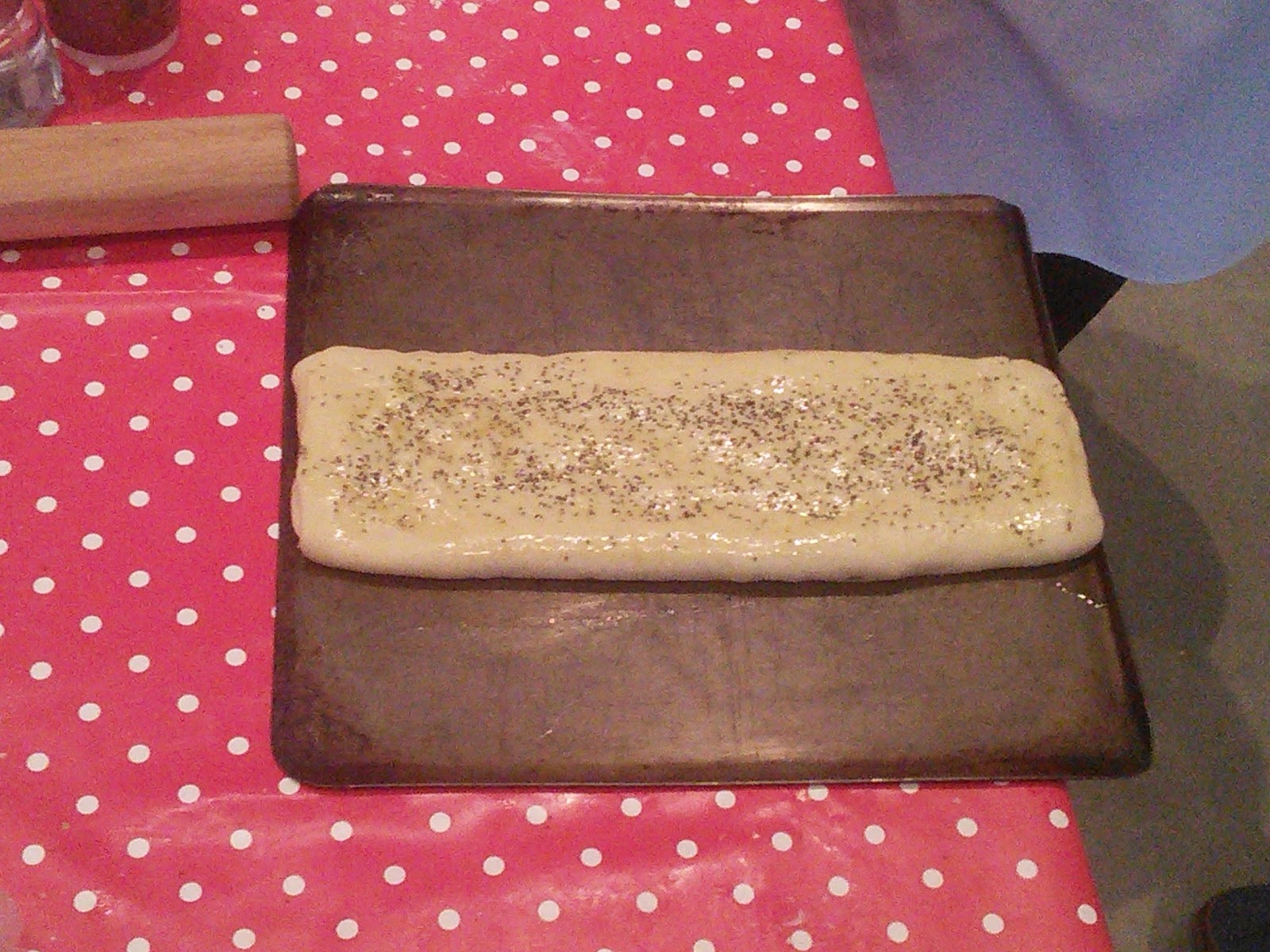


Bouran said that at home this would then be rolled flat again, to within a millimetre of its life, but as that was a bit tricky, we should quit while we were winning, advice that we were all too happy to take.

Leftovers


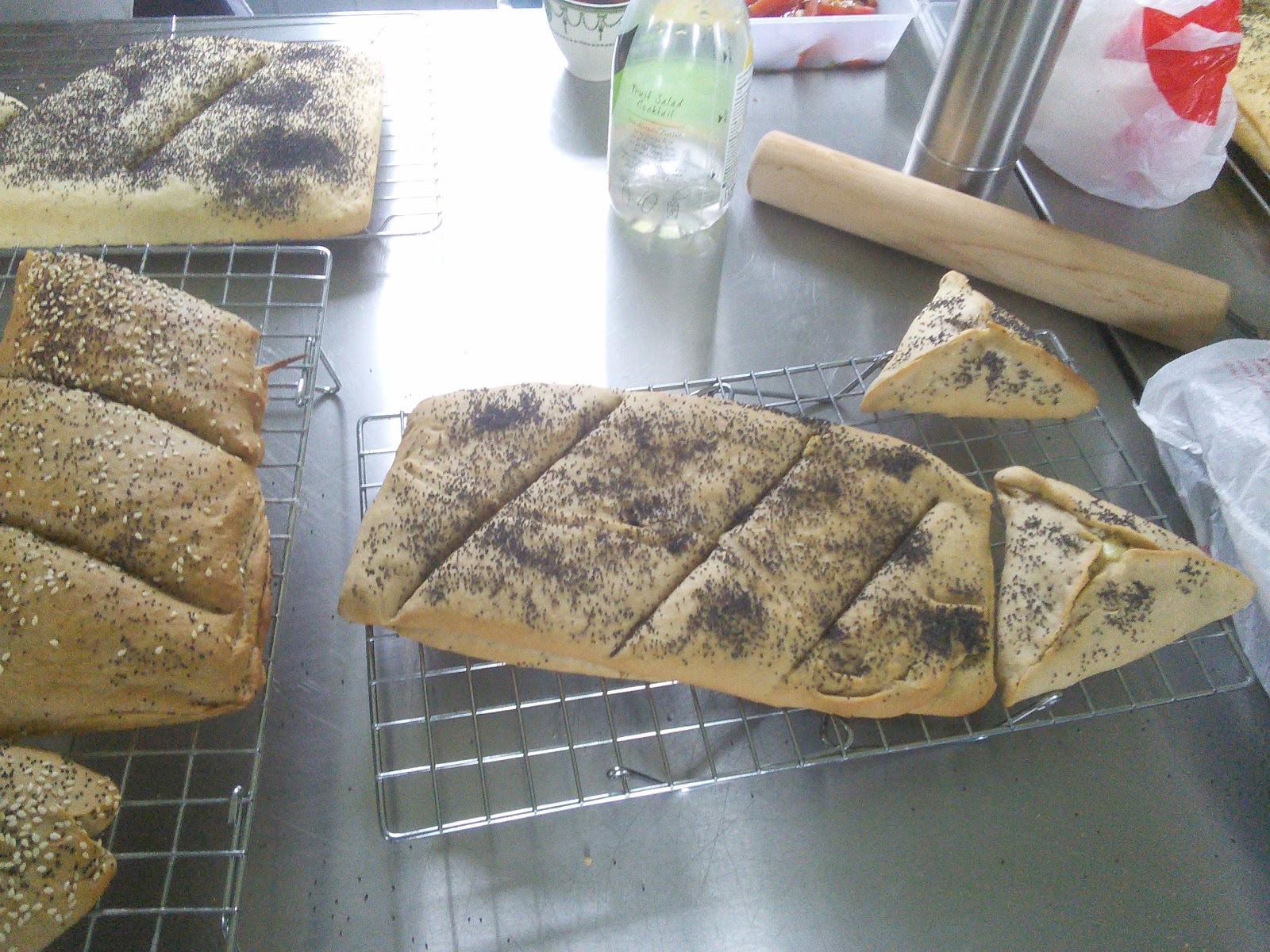
A good cook will always have some left over, and Bouran made sure she had some dough left over to show us some other favourites. These leftover pieces of dough below were all rolled out into circles, and filled with the same feta and thyme mix as the bread -


The two boat shapes on the right were formed by simply lifting up the edge round the filling to form a rim, and pinching the rim together. It's a subtle difference, but simply pinching from the outside of the rim, so that the two inside parts stick together is traditional in one country (can't remember which) and making a fold so that two outside parts are pressed together is traditional in another country.  The visual effect is very similar but you can see the difference here, pinched on the left, folded on the right -


The seedy one at the bottom is simply a circle, half covered with filling and folded in half.


The edges are pinched to seal them, and then the whole thing is dipped generously in seeds. I think these were poppy seeds.


The rather effective triangular shape, which Bouran calls a turnover, also starts as a circle, with filling in the middle. If you think of the circle as a clock face, you simply pinch together the edges at 11 o'clock and 1 o'clock; then 10 o'clock and 2 o'clock. As you continue to pinch, you will find you are pinching nearer and nearer the middle of the circle. When you get to the middle, pick up the edge at 6 o'clock on the clock face and pull it into the middle, to join what you have and pinched so far. At this point, it becomes obvious that you have two other seams that need pinching, radiating out from the middle of the clock face towards 4 o'clock and 8 o'clock. Pinch away, and you will soon find you have a tidy triangular parcel.


These were decorated with sesame seeds.

Unfamiliar spices


Bouran's next recipe was quite different. A spicy biscuity cake traditionally served at weddings. There were three surprisingly strong flavours which went into these. The strongest, which developed over time when I kept a few pieces at home, was aniseed. To the western tastebud, this seemed a bit overpowering, but it's a case of what you are used to, I am sure.

Then there was mahlab, the seed of a wild cherry. This is ground up in a mortar and pestle.


This was a very interesting flavour, altogether, and completely new to all of us. We had a good sniff of the precious powder in its little bag.


There was a third spice, which escapes me for the moment. One of the spices made the cake very yellow.


The result was somewhere between a biscuit and a cake, but not at all sweet. We were a little baffled to be honest, but it was certainly a new taste experience for everyone. And I have to say they grew on me as they aged a little at home. What was fascinating was how unfamiliar this taste was to us, yet it was completely familiar to Bouran.


More recognisable as elevenses fodder were these almond topped biscuits, with a full quota of fat and sugar.


Any resemblance to a gingerbread man is purely coincidental. Once baked, they looked very biscuity.


Bouran told me she was amazed by how much sugar we Brits consume, and it was her considered opinion that the way to please the British taste was to put loads of sugar and fat in. Whatever the recipe, sugar and fat was the way to make it popular. Very perceptive, I thought! All that is required then is a cup of tea to wash it down with. Mint tea, of course. There are a surprising number of different kinds of mint in the garden, and they all seem to work quite well as a drink. You can be as careful or as careless as you like - it works fine if you just grab a handful of mint and put it straight in a cup, and pour on some boiling water. Or you can get picky if you like. I'd heard of mint tea being served with lots of sugar, but it is very nice without any. What I wasn't expecting was to find that it is usually added to weak black tea rather than being brewed on its own.


We all then tucked in to our lunches, tasting the breads and turnovers alongside whatever was in our lunchboxes, and talked over the day's baking.



Tip for bloggers


I had a bit of a nightmare with this blog. I was deleting a sentence by repeatedly pressing Ctrl-z to undo a word at a time. All was going fine, but then suddenly everything disappeared, leaving me with a blank blog. This happened to me once before, and all I learned from that experience was that panicking was no help at all. So this time I made sure not to close my Blogger window, and went away to have a think about it. Eventually I realised that Ctrl-z was undoing "things that had happened since I opened the blog" rather than "things I had typed". And the first thing that had happened when I opened the blog was that all the contents were loaded, and I had accidentally undone that and effectively unloaded all my text. So the solution was to do Ctrl-Y to redo the action I had lost, and hey presto the text reappeared. Moral: stay calm and carry on.

Monday, 27 July 2015

Baking barmy

It's the middle of summer and Bread of Heron, the Heron Corn Mill's community bread group is supposed to be having a well earned summer break. But we can't seem to stop baking at the moment - we must have the baking bug!


Baking for Freedom from Torture


Andy in the Heron Corn Mill office suggested we might do some baking in support of this bread group, run by Freedom from Torture (FFT). Although we are not a campaigning or political group in any sense, I think it is fair to say that the main thing we have all found about baking as a group is that we all support each other.


None of us is outstandingly skilled at what we do, but we seem to manage to produce good results week after week - and we enjoy ourselves along the way. Getting together as a group of fairly naive hopeful bakers is important because we all benefit from the good will we are surrounded by. Our goals are straightforward: we are doing something wholesome and simple (except pitta breads, which are far too complicated), and everyone respects everyone else's efforts, and wishes them well.


Baking bread may not be a blue print for building a perfect society, but it does certainly provide a little oasis of peace and pleasure in the middle of whatever kind of life we may have otherwise.


Reading the comments on the FFT bread group's blog, you can feel their members are getting a similar kind of simple satisfaction out of their breadmaking, only these are people who really need that helping hand from a supportive group.


We held an extra baking day to raise funds for the FFT bread group, and Stuart laid on a mill tour. The idea was that by lunchtime we would have lots of nice fresh bread to sell to people who had been on the mill tour. Customers would glide smoothly out of the mill, and bread made using Heron Corn Mill flour would glide smoothly out of the hut to meet them in the barn.The bread would be snapped up by happy customers in return for kind donations to the FFT group. No pressure then! The amazing thing is it pretty much turned out like that in the end.


We had some extra hands making bread with us to make sure there was enough to go round.

The Heron Corn Mill staff came out in numbers, some baking, some arranging the shop space in the barn, and Stuart grinding away in the mill itself. There was a good turnout across both halves of the baking group, and we had volunteers helping out on the mill tour as well.

Some of our extra hands hadn't made bread for a long time, and some not at all. But we all produced good bread, and there was lots of variety of styles, so our customers had a genuine choice. Audrey and Andy both did round cobs, which was interesting, because they both took the bold option of letting the bread rise on the tray, rather than in a basket or a tin. The finished product, complete with decisive slashes, looked great in the shop (picture lower down).


Bouran our honorary member from Palestine was in town too, and came along to bake with us. Her za'atar rings started off as a straightforward bread dough, except that she rubbed lots of olive oil into the flour before adding the water.


After letting it have a good rest, Bouran rolled the dough out to within a millimetre of its life. It is quite a skill to arrive at a large thin piece of dough. You have to keep turning the dough to stop it sticking, assessing which parts are thicker than others and adjusting accordingly.

Once her dough was rolled really thin, she brushed more olive oil all over, sprinkled very generously with za'atar which came with her from Palestine, and sliced the whole thing into about 6 strips. The strips were pinched together at both ends, and with a little help from the other side of the table and a rapid contrary motion at the two ends, twisted into a long twisty thing as shown below.


This is clearly a trick you need to learn at your nanna's kitchen table!

I have to say at this point that I was completely in the wrong when I urged moderation in the use of za'atar powder at a previous meeting of the bread group. I can see it now. It seemed a little flamboyant to spray it about like a supermodel sloshing Chanel Number 5 around on the adverts. But as Bouran explained, za'atar (thyme) grows everywhere, and it is used in cooking like it was going out of fashion. The trick is, of course, to grow your own thyme at home, in abundance, and use it by the armful, freshly picked. The dried za'atar powder that we have been getting from various suppliers locally is authentic enough, but the only ingredient in the mixture which is absolutely essential is the thyme itself, and we shouldn't worry too much about the over all mix, so long as we can throw the thyme itself around like confetti. I have seen the light: think "whazz" not "sprinkle".


You can see from the worktop that the oil has made sure the za'atar stuck to the dough, and didn't fall off during the Great Twisting. But the twisted dough was starting to look a bit like an Egyptian mummy, so it had to be cut in half. It was certainly big enough for two loaves.


Having got the dough under control, the next step was to shape it into a ring and join the two ends. 


Then repeat the whole thing for the other piece.


And having done the hard bit, arrange nicely on baking trays to rise. Simples!


With so much being baked, we had quite a queue at the oven. Total griddle lock, in fact.


Finally, everything got through the burning fiery furnace in one piece, and we could start laying out our stall. The scones and a particularly delicious tray of shortbread catered for the English sweet tooth.


And then the bread in all its shapes and sizes, and with that irresistible smell -

"the very palatable odour indeed of our daily bread, of all commodities of the public the primary and most indispensable".  (Ulysses chapter 16)
There were a couple of Heron Corn Mill spelt loaves, which I have come to the conclusion work best in a tin. It can be a bit difficult to slice a loaf which has spread across the oven till it is shaped like a discus. Apparently the gluten in spelt is not so strong as that in wheat, so it does not stand up as well without support. These particular loaves had risen just about as high as the tins would support them, so they didn't reach the oven a moment too soon.


And no bake off would be complete without a couple of sourdoughs. I mixed the sponge for these during the morning of the previous day, and worked the dough in the evening. I put the loaves in the basket before bedtime, and they spent the night in the fridge inside a couple of plastic bags each. This seems to work reasonably well. You take the bread out of the fridge when you get up, and it is still cold when you transport it to the mill. The dough is happy enough with just being put under the workbench to warm up in its own good time, and towards the end of the morning it is ready to go in the oven. It looks a little dried out when it comes out of the basket, so maybe I need to do some moisturising. But so long as it has plenty of time (and no pressure) to come back to life, this suspended animation approach seems to be a viable way of making sourdough somewhere other than where you intend to cook it. The results certainly look good, and the flavour definitely benefits from the 24 hour cycle from sponge to oven. Just look at the bubbles exposed by the slash to the left of the label.


We really must try this as a group!

It's amazing what you can do when you get together and go for it. We actually produced a rather nice selection for people to choose from, and all fresh from the oven.


All the baking was then moved across to the barn, where we set up a little shop for the morning. People who had been on the mill tour with Stuart came on down to the barn for a chat and a cuppa. I think pretty well everybody chose some bread to take home in return for a donation to the funds of Freedom from Torture. The grand total raised was £162, which I think is a very good result. And in addition we raised a few people's awareness (mine included) of the work Freedom from Torture does. All in all it felt like a really good thing to have done, and thanks to the bread group members and the Heron staff for all their help.


If you would like to know more about Freedom from Torture, you can read about what they do on their website.

OED online - what price a word?

I'm sure you know by now that I enjoy a good word. After a good slice of bread, there's nothing to beat a good slice of the English language. It's always nice to see Pauline's Editor's Word of the Month at the end of the Heron Corn Mill newsletter, for instance. My word of the month is coming, lower down.

What you may not know is that the wonderful Oxford English Dictionary has in effect been donated to the nation. Provided you have a valid library card, you can log in at www.oed.com and search the full Oxford English Dictionary online. This is free access, with no strings attached, to the most comprehensive English dictionary ever: 20 printed volumes on the shelf, 21,728 pages, a snip at £750, and yours for free on line.

I eventually parted with my small-print version of the OED because I also have a copy on CDs, and I found I was not using the printed one any more.

But now you can access this really wonderful language resource completely free online. It's bang up to date with all the latest words that have snuck into the language recently. As my mate said - what's not to like about that?

If you want to take advantage of this great linguistic give away, just get your library card, and go to www.oed.com. You can "Create a profile" by entering your library card number, email address and a password of your own choice. Then you can "Sign in" by typing just your email address and password, which should be easier to remember than the library card number.

Once you "Sign in", you will have full access to the OED online for free.


Christmas really has come early! And here is my word of the day - no prizes for guessing what it is.

breadn.

Pronunciation:  /brɛd/
Forms:  OE bréad, ME bread, (ME brad), ME bræd, ME–16 bred, (ME bredd), ME–15 brede, (ME bryadbryead), ME–15 breed(e, ME–16 breade, 15– bread, ME– Sc. breid, (15–16 bredde, 16 braid, 18 dial.brade).
Etymology:  Old English bréad , plural bréadru : repr. West Germanic *braud , and corresponding to Old Frisian brâd , Old Saxon brôd (Middle Dutch broot-de , Dutch brood , Low German brôd , brood ), Old High German, Middle High German brôt (German brod , brot ); Old Norse brauð (Swedish, Danish bröd ) < Germanic *braudoz- , a neuter -os stem, not preserved in Gothic. The original Germanic name for bread survives in the modern loaf n.1(Old English hláf, Old High German hleib, Old Norse hleifr, Gothic hlaifshlaibs, Germanic *hlaibo-z) formerly in all the languages in the sense of ‘bread’ and ‘loaf’. Braudoz-brôdbréad, appears to have originally meant ‘piece, bit, fragment, Latin frustum’: but already in Old Saxon and Old High German it had the acquired sense of ‘bread’; ‘Old High German shows no clear distinction of meaning between brôt and hleib’ (Sievers). In Old English bréad is rare: the later Blickling Glosses have the plural bréadru, ‘frusta’ (i.e. ‘pieces, bits’). The other examples are all Northumbrian, in the Lindisfarne (& Rushw.) gloss; viz. John xiii. 27, 30 translating buccella, the ‘mouthful’ given to Judas, for which the Ags. Gospels have bitan, Wyclif morsel, Rhemish morsel. In verse 26 where the Vulgate twice renders the same Greek word (ψωμίον bit, piece) by ‘panem’, later versions ‘bread’, the Ags. has hláf, Lindisfarnelaf, which seems to show that bréad was not yet identified with panis. But in John vi. 23, bréad actually represents panem of the Vulgate (= ἄρτον), and hláf of the Ags. version: where however broken bread is in question. Before 1200 bread had quite displaced hláf as the name of the substance, leaving to the latter the sense ‘loaf’ which it has since retained. It thus appears that a word originally meaning ‘piece, bit, frustum’, has passed through the senses of ‘piece of bread’, ‘broken bread’, into that of ‘bread’ as a substance; while at the same time the original word for ‘bread, loaf, panis’ has been restricted to the undivided article as shaped and baked, the ‘loaf’. The Lowland Scotch and northern dialect use of piece illustrates anew the first step in this transition, for it is the regular word for a piece of bread, as in ‘give the bairn a piece’, ‘a beggar asking a piece’, a ‘piece-poke’, a ‘gie's-a-piece’ i.e. a beggar.
So also in Slovene, ‘kruh , “bread” is literally “a piece, something broken off”’ (Miklosich, Etym. Wbch. Slav. Spr. 143).
With brôd , bréad , Prof. Sievers connects the German brosame crumb, in Old High German brôsma , Old Saxon brôsmo < Germanic braudsmon- , the sense of which confirms the original meaning of *braudoz- , and points to some root having the sense of ‘break’. Old English bréotan does not answer phonetically. (The preceding facts are, of course, quite inconsistent with the conjecture that bread is a derivative of the verb-root bru to brew v.)

1. (Only in Old English) Bit, piece, morsel (of food). See above in Etymology.

 2.

 a. A well-known article of food prepared by moistening, kneading, and baking meal or flour, generally with the addition of yeast or leaven.

c950   Lindisf. Gosp. John vi. 23   Neh ðær stoue ðær geeton þæt bread [Ags. Gosp. þone hlaf].
c1175   Cott. Hom. 233   Hi hadden brad and win and vii sandon.
c1200   Moral Ode 191 in Trin. Coll. Hom. 225   We ȝieueð..a steche of ure breade.
?c1200   Ormulum (Burchfield transcript) l. 1590   Þerrflinng bræd iss clene bræd.
1340   Ayenbite (1866) 107   A zop of hot bryead.
c1383   Wyclif Sel. Wks. III. 443   Þis sacrid ooste is verrey Goddis body and verrey breede.
a1400  (▸a1325)    Cursor Mundi (Vesp.) l. 15233   Takes and etes o þis bred, For fless þan es it min.
1413   Lydgate Pilgr. of Sowle (1483) v. xiii. 104   This breed and this wyn the hyhe kyng blessith with his hand.
c1440   Bone Flor. 1004   Be hym y sawe in forme of bredd, When the preest can synge.
1562   J. Heywood Prov. & Epigr. (1867) 30   Better is halfe a lofe than no bread.
1600   P. Holland tr. Livy Rom. Hist. xlviii. 1237   To chew his bare bread.
1609   J. Skene tr. Regiam Majestatem 151   They make not breid agreand to the money.
1655   T. Moffett & C. Bennet Healths Improvem. xxv. 236   Bread and Cheese be the two targets against death.
1736   W. Ellis London & Country Brewer II. 8,   I don't care how white my Bread is.
1799   tr. J. H. Meister Lett. Resid. Eng. 228   You write bread, and you pronounce it bred.
1843   T. Hood Song of Shirt v,   O God! that bread should be so dear, And flesh and blood so cheap!

 b. The plural has been used as a literalism of translation (obs.); also in sense of ‘kinds of bread’; and colloq. of individual portions or helpings of bread.

1547   A. Borde Breuiary of Helthe i. Proheme f. iiiiv,   They muste knowe the operation of all maner of breades, of drynkes, and of meates.
1579   W. Fulke Heskins Parl. Repealed in D. Heskins Ouerthrowne 140   Three sundry breades are mentioned by Christe.
1610   Bible (DouayII. Prov. xii. 11   He that tilleth his land, shall be filled with breads.
1610   Bible (DouayII. Psalms xl. 10   The man also..who did eate my breades.
1865   Pall Mall Gaz. 11 Oct. 3   By two o'clock we were all seated, nibbling at our breads in a famished way.

 c. With qualifying words.ammunitionbarley-blackbrown bread, etc.: see the first element.

1549–62   T. Sternhold & J. Hopkins Whole Bk. Psalms cxxvii. 2   Feeding full hardly with browne bread.
1616   G. Markham Countrey Farm v. xx. 578   Of the meale wholly together..is made houshold bread. And when the greatest of the branne is taken away, then there is usually made thereof citizens bread.
 3.

a. (With pl.) A loaf, a roll; also, a broken piece, or fragment, of bread. Obs.

c1400  (▸?c1380)    Cleanness (1920) l. 1405   Burnes berande þe bredes vpon brode skeles.
?a1500   R. Henryson tr. Æsop Fables: Sheep & Dog l. 1183 in Poems (1981) 48   Ane certane breid, worth fyue schilling or mair.
a1530   W. Bonde Pylgrimage of Perfeccyon (1531) iii. f. Clxxxxii,   The .xij. baskettes of breedes yt remayned..in yt great myracle of our lorde.
1535   Bible (Coverdale1 Kings xix. 6   At his heade there was a bred [ Wyclif loaf] baken on the coles.
1609   J. Skene tr. Regiam Majestatem 134   Gif ane man is taken..with ane bread, the price of ane halfe pennie.
1643   W. Prynne Soveraigne Power Parl. ii. 32   Scarce a penny bread a day to support their lives.

 b. In full altar-bread. A sacramental wafer. Usu. pl.

1849   D. Rock Church of our Fathers I. ii. 144   Altar-Bread was unleavened.
1849   D. Rock Church our Fathers I. ii. 149   Irons for baking Altar-Breads.
1877   J. D. Chambers Divine Worship Eng. 352   The Breads being now on the Corporal.
1899   W. J. S. Simpson Mem. W. S. Simpson 154   An iron instrument for stamping the altar breads.
 4.

 a. Taken as a type of ordinary food or victual. (Perhaps from the Lord's Prayer.) bread of idleness: food not worked for; so similar phrases, asbread of affliction, etc. †full of bread: full-fed.

c1175   Lamb. Hom. 63   Gif us to dei ure deies bred.
1340   Ayenbite (1866) 110   Vayre uader oure bryad of eche daye yef ous to day.
a1382   Bible (Wycliffite, E.V.(Douce 369(1)) (1850) Isa. xxxiii. 16   Bred to hym is ȝoue, his watris ben feithful.
a1425  (▸c1395)    Bible (Wycliffite, L.V.(Royal) (1850) Deut. xvi. 3   Thou schalt ete breed of affliccioun.
1535   Bible (CoverdaleExod. xxiii. 25   So shal he blesse thy bred & thy water [ Wyclif, looues, and watris].
c1540  (▸?a1400)    Destr. Troy 13549   Me bus, as a beggar, my bred for to thigge.
1597   Shakespeare Richard II iii. i. 21   Eating the bitter bread of banishment.
1604   Shakespeare Hamlet iii. iii. 80   A tooke my father grosly full of bread.
1611   Bible (King JamesProv. xxxi. 27   She..eateth not the bread of idleness [ Wyclif, idil bred; Coverdale bred with ydilnes].
1611   Bible (King JamesEzek. xvi. 49   Pride, fulnesse of bread, and aboundance of idlenesse was in her.
1700   Dryden tr. Ovid Of Pythagorean Philos. in Fables 508   If Men..chaw with bloody Teeth the breathing Bread.
1832   F. Marryat Newton Forster I. xi. 140   You cannot..eat the bread of idleness on board of a man-of-war.
1842   Tennyson Lady Clare in Poems (new ed.) II. 196,   I speak the truth, as I live by bread!

 b. fig.

c1380   Wyclif John vi. 35,   I am breed of lyf.
1542   T. Becon Potacion for Lent sig. F.vjv,   Touche not the theuish breades of peruerse doctryne.
1660   Bp. J. Taylor Worthy Communicant i. §1. 21   The holy Sacrament..the bread of elect souls.
1875   P. G. Hamerton Intellect. Life (ed. 2) x. iv. 358   The daily bread of literature and art.
 5.

 a. Livelihood, means of subsistence.

1719   D. Defoe Life Robinson Crusoe 4,   I was under no Necessity of seeking my Bread.
1727   A. Hamilton New Acct. E. Indies II. xxxv. 31   Poor miserable Fishers, who get their Bread out of the Water, to keep them from starving.
1777   E. Burke Corr. (1844) II. 170   The bread of a family depends on that man's paralytic hand.
1801   M. Edgeworth Prussian Vase in Moral Tales III. 11   You..make your bread by your..pen.
1822   Byron Vision of Judgm. xcvi,   He meant no harm in scribbling..'twas..his bread.
1849   T. B. Macaulay Hist. Eng. II. 142   Many officers..arbitrarily deprived of their commissions and of their bread.

 b. in good bread: in a good living or position (?obs.); in bad bread: in a bad state, in difficulties; in disfavour with a person. dial. and U.S.

1763   in Essex Inst. Hist. Coll. (1913) XLIX. 139   Mr. Barnard..is now in good bread, and seems loth to affront his people by telling them plainly of these public sins.
1778   in Essex Inst. Hist. Coll. (1907) XLIII. 11   Old England I beleve is got into Bad Bread.
1778   in Essex Inst. Hist. Coll. (1907) XLIII. 16   Hope it is the French Fleet, if not we shall be in Bad Bread, but we must see it out with them.
1785   F. Grose Classical Dict. Vulgar Tongue at Bread,   In bad bread; in a disagreeable scrape, or situation.
1825   J. Jamieson Etymol. Dict. Sc. Lang. Suppl. (at cited word),   To be in bad bread, to be in a dilemma, or in an evil taking.
1881   J. Sargisson Joe Scoap 139 (E.D.D.)   That's hoo he gat inteh sec bad bread with t'maister.
1894   P. H. Hunter James Inwick xviii. 223,   I saw fine I was gaun to be in bad breid wi' baith sides.

 c. Money. slang (orig. U.S.).

[1939   F. Ramsey & C. E. Smith Jazzmen (1940) iii. 63   Inside the low, smoky room, the musicians sweated for their bread.]
1952   Down Beat 18 June 15   If I had bread (Dizzy's basic synonym for loot) I'd certainly start a big band again.
1965   L. W. Holt in J. H. Clarke Harlem 207   There won't be much ‘cake’ unless the brothers should happen to get some bread to buy it with.
1967   C. Drummond Death at Furlong Post iii. 28   So me with all that bread..maybe a week, and then I get the plane.
 6. Extended to various preparations of the composition or nature of bread.

a. Pie-crust; pastry. Obs.

a1400  (▸a1325)    Cursor Mundi (Vesp.) l. 4487   A lepe..Wit bred þat i bar on mi heued.
c1420   Anturs of Arth. xxvii,   Briddes bacun in bred.
?c1475   Sqr. lowe Degre 319   Wyth byrdes in brede y bake.

b. Sea-biscuit. Obs.

1651   Severall Proc. Parl. No. 84. 1289   We have taken..2 casks of Bread, and one barrel of Pease in one Vessel.
1746   in W. Thompson Royal Navy-men's Advocate (1757) 18   The Bread..is all good, but..it has been..long aboard.
1793   Pitt in G. Rose Diaries (1860) I. 128,   I rather imagine he uses the term bread, as synonymous with biscuit.

 c. Other preparations of corn or flour. U.S.

1863   Life in South II. 237   An abundant supply of cold chicken, ham, and ‘breads’, as all the variety of corn cakes, waffles, hot rolls, and hominy are called.

 7. Short for bee-bread n.   (In 17th c. pollen.)

1682   N. Grew Anat. Plants iv. ii. v. §1   That Body which Bees gather and carry upon their Thighs, and is commonly called their Bread... The Bread is a Kind of Powder; yet somewhat moist.