Sunday, 15 November 2015

Pane de Pèlerinage

Tobias Smollett travelled for the good of his health and left a very entertaining account of what he got up to in his book "Travels through France and Italy".


Franz Liszt went for the scenery as much as anything. He took in Switzerland and Italy and left a musical diary of the places he visited in his Années de Pèlerinage.


The trouble with these otherwise worthy attempts to convey the joys of a trip to Italy is their complete failure to cover one of the most important things -

Bread!


I have decided to put the world to rights, inspired by Charles Pooter's preface to his "Diary of a Nobody" -

"Why should I not publish my diary? I have often seen reminiscences of people I
have never even heard of, and I fail to see - because I do not happen to be a
Somebody - why my diary should not be interesting. My only regret is that I did
not commence it when I was a youth."
So here's to the joys of Italy, not least...
Pane!

Florence


The most interesting place in Florence for food is undoubtedly the mercato centrale. Not only does it have the best of everything in the downstairs food stalls, it also has a trendy upstairs eating area which is open to midnight, and is really good fun to walk round. You can get all the local delicacies - tripe, massive T-bone steaks, fresh pasta, pizza - you name it. My favourite place up there had a sign up saying "lievitato solo con madre" - everything sourdough. "Everything" included bread, cakes, pizza, the works.

I got a proper arancino here, and was sold it by a young lady who could easily have been Nigella's daughter. It was well worth the 3 euros!


And what could be better for pudding than half a ton of cantuccini?


And for a late supper after a night on the tiles, how about a calzone (deep fried pizza)?


This is an interesting one - charcoal bread. It's approximately 6 g of powdered charcoal added to 500 g of flour, and then made up into a very firm dough, around 50% hydration. Good for flatulence, so they say!


Somebody had a bad day with this "ruota" (Italian for "couronne") on the right: it definitely looks pasty in the middle -
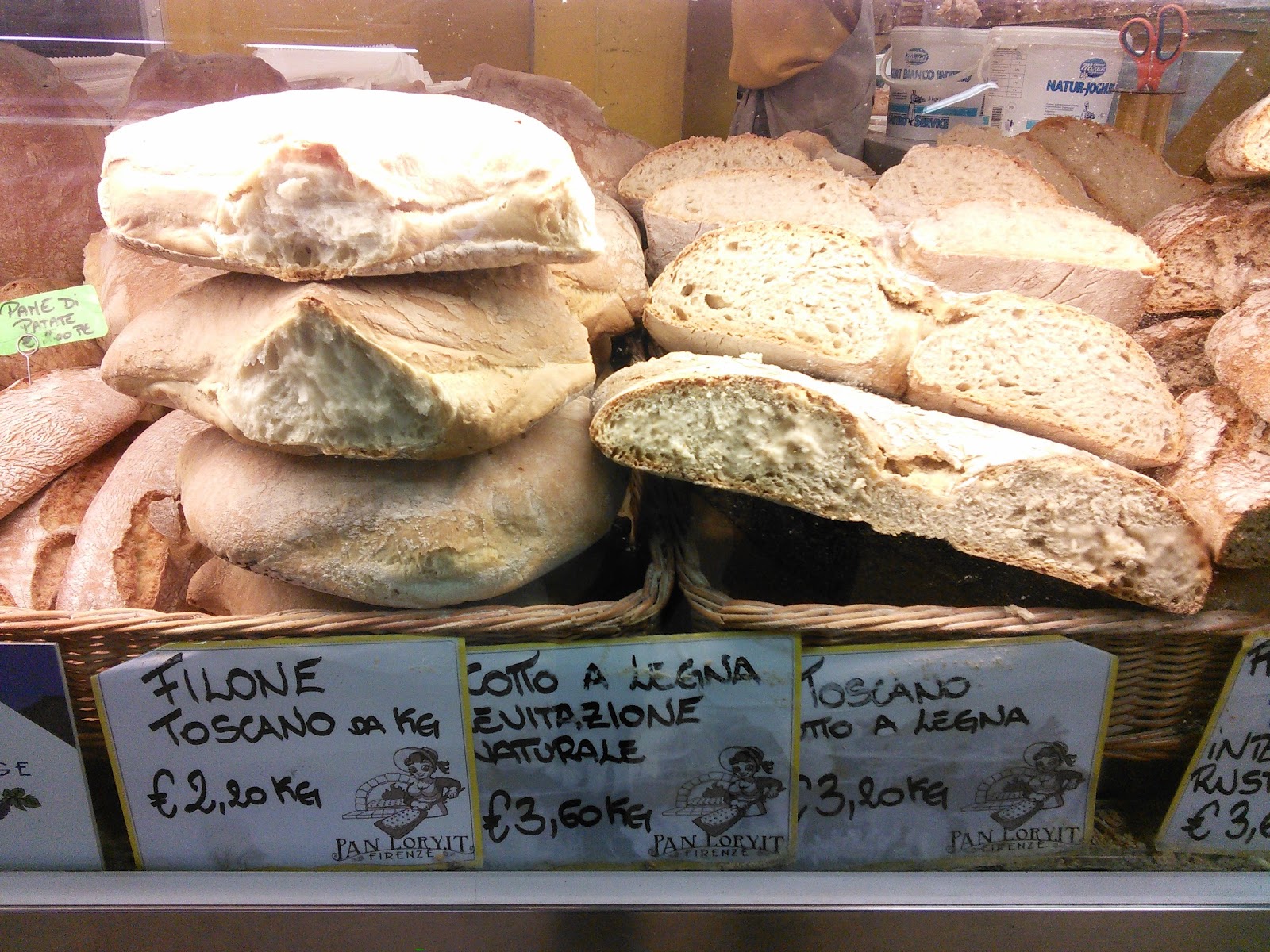


In this next picture you can see the local element in the Italians' pride in their bread. Reading the labels from left to right -

  • general purpose Tuscan wood fired
  • three varieties (white, wholemeal and rustic) of bread from the next town along, Prato
  • Puglian from the south
  • Florentine salt free filone.


Can you imagine going to Milnthorpe market and being offered a choice of traditional Cumbrian, Kendal white, wholemeal and rustic, Somerset, or Milnthorpe? It isn't going to happen any time soon, but amazingly we are starting to have choices - Staff of Life in Kendal, Lovingly Artisan at Plumgarth's, More? at Staveley, Filberts in Lancaster. It's the tradition we are lacking, and that will take some making up for.

Cranky? Or is this the way to go?


This kind of specialist stall might easily be dismissed as cranky in England, but in Italy it is much more of a mainstream thing. Reading the labels from left to right -
  • wholemeal spelt, water, natural levain, salt
  • wholemeal wheat, water, oily seeds, natural levain, salt
  • wholemeal wheat, water, natural levain, salt
  • tipo 2 flour, wild wheat (einkorn), water, natural levain, salt


Duro versus tenero


Here's one you don't see very often in England: "soft flour, stone ground, type 2, obtained from ancient grains, organic, local, direct from the producers". Soft flour is more common across Europe than the "durum" wheat we use.


The key difference between "duro" and "tenero" grain is the protein levels. You can see from this table of soft grains that the protein is significantly lower than the 12-13% we typically see on our bread flour -

Flour typeAsh contentExtraction RateProtein
Type 00< .5%50%7 to 9%
Type 0.51 to .65%72%9 to 10%
Type 1.66 to .80%80%10%
Type 2.81 to .95%85%10%
Integrale1.4 to 1.6%10%
So the flour in the picture above is roughly 10% protein and 85% extraction. And these are the grains involved -
  • verna
  • mec
  • marzotto
  • abbondanza
  • rieti
If your Italian is up to it, here is a learned paper on the development of grain types, including these ones, over the 20th century. They really do take this seriously in Italy!

A bit of art


Here is a pictures of me with Donatello's David in the Bargello. I would have included a similar shot of the David in the Accademia, but my proof reader declared "enough naked men already".


Bridget Riley eat your heart out


And relax


After all the excitement and bustle of our week in Florence, we wound down a little with a couple of day trips to sleepy medieval towns nearby. Italy's trains are great, and you don't get all the nonsense of variable ticket prices that we have to put up with in this country. You pay for the distance you travel, simple as that.

Arezzo


Like most places in Italy, Arezzo has not only a cathedral but also at least one other large and ancient church. Rabbi Lionel Blue told a joke on Desert Island Disks about the Jewish castaway. He spent many years on the island and when he was finally rescued, his rescuers were amazed to find he had singlehandedly built two synagogues. "But why two?" they asked. "Well I don't go to that one!" he replied.

Arezzo's beautiful Chiesa di Santa Maria della Pieve is really old, and has plenty of art inside. The front of the church faces a broad Siena-like piazza. But the most amazing part is this set of columns across the back, the oldest dating back to the 1200s, all of which are subtly different -


What we actually went for were the Piero della Francesca frescoes in the Basilica di San Francesco.


These really were quite something. As Pope Francis was visiting Florence while we were there, the Galleria dell' Accademia in Florence had their best Franciscan art buffed up and prominently on display, so we were certainly not short of Franciscan influences on our holiday.

In the end we didn't go to the Cathedral in Arezzo, where we would have seen this -
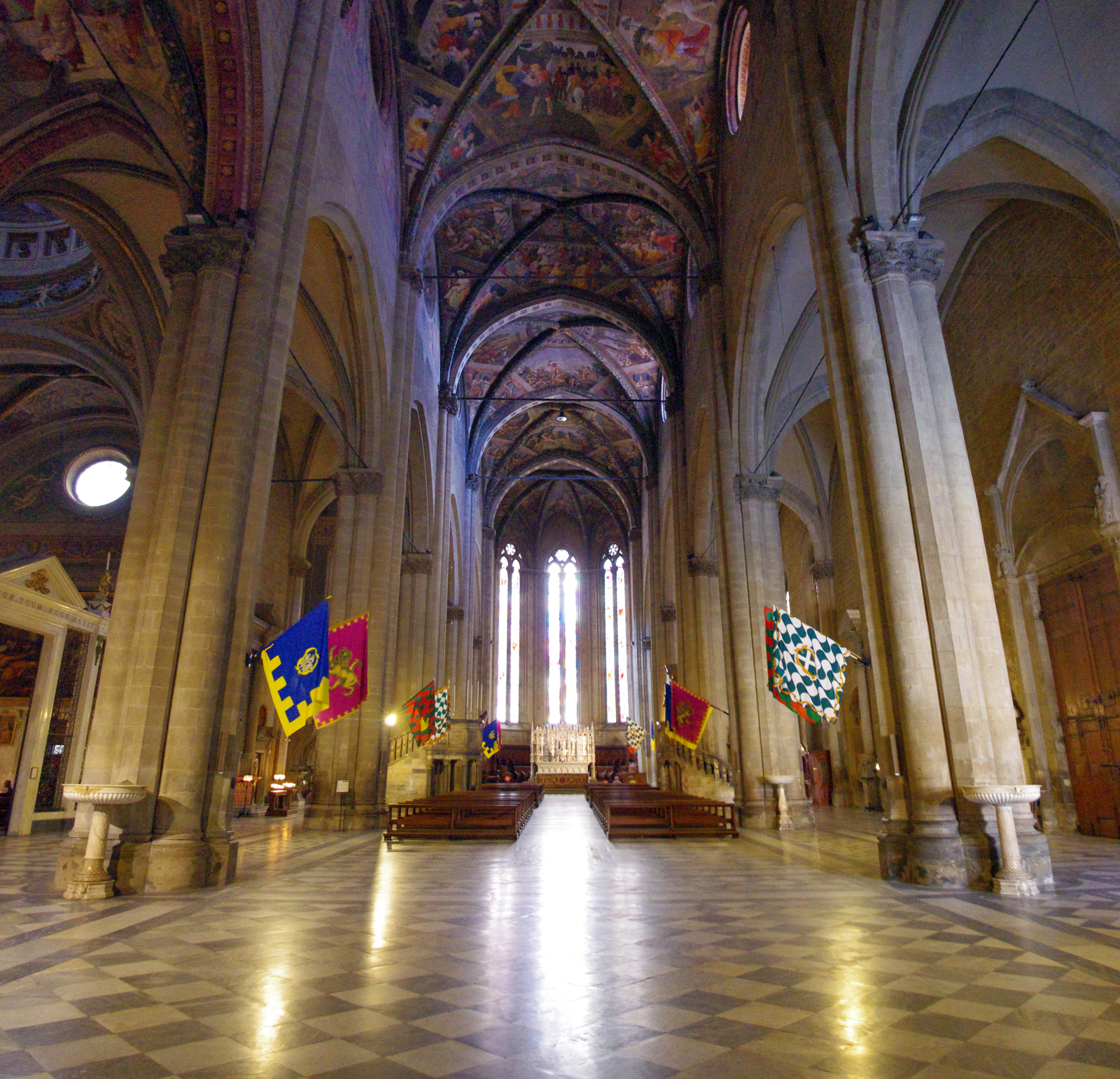


Still, you can't do everything, can you? Instead we walked along part of the medieval town walls, and took in the view.


Pistoia


This is a lovely little place half way from Florence to the west coast. The earliest town walls were built in the eighth century. As the town grew, a second larger set of walls was built in the twelfth century. A third set was built in the fourteenth century. Rather shockingly the four old city gates were all knocked down in the early twentieth century to make room for "seemingly better urban development" as described here.

There is a nice little market between the cathedral square and the ancient church of San Giovanni Fuorcivitas, both of which are worth a look. Here you can see chestnuts, fresh green and black olives, and mushrooms at 40 euros a kilo.


On the same market stall you can see how seriously they take their flour in Italy. This basket of cake flour is celebrated like a new addition to the family -

Surname... Flour
First name... Sweet
Born at... Cuneo (west of Genova)
On... 02/11/2015
Distinguishing features... Very sweet


And then finally let's cut to the chase - fancy flour costs 13 euros a kilo! "Farina dolce" is made from walnuts, so it's no coincidence that they displayed  it next to the walnuts.


Here is some flour Stuart would be proud of - "authentic organic flour stone ground naturally since 1956" and there's a picture of the stones to prove it!


What the Jiggins are these? I'd never heard of testaroli before.


It turns out they are pasta pancakes. These were in a posh food shop in Pistoia, and they are made by Lucchi and Guastalli, a very posh oil producer.

So that's all from Tuscany.

Ciao for now.

Monday, 2 November 2015

Why wetter is better

I made a bread machine loaf today. Shock horror!

It's true: even bakers at Bread of Heron, the Heron Corn Mill's community bread group, occasionally use a bread machine. It's a very convenient device, and does a pretty fair job of making fresh bread with a minimum of effort. So why am I telling you this? Because today's loaf came out like a brick. This also happens.


Occasionally we forget the yeast, or the water, or the bread machine paddle. Very occasionally we use ingredients which are ever so slightly past their best before date. But none of the above applied this time. The yeast was fresh, the water was straight from the English Lake District, so nothing wrong there.


The flour was only a few weeks old. I know because I helped at the mill the day it was milled, and it is my handwriting on the bag where it says "Paragon Wheat. Best before 7/2/2016". Nothing wrong with the flour then - far from it. So what the Jiggins went wrong? And why does this happen once in a while?


It's our old friend hydration again.


Follow me closely now... I bought some excellent flour from the Woodbridge Tide Mill a couple of years ago, and the miller there told me that in his opinion home bakers were being given bad advice by TV food programmes. That's him on the right.


It was quite trendy at the time to make "no knead" or "low knead" bread, on the basis that you didn't really need to knead provided you gave the bread a bit longer to rise. Certainly it is possible to make ciabatta, for instance, with no kneading, masses of water and a 20 hour rise time. But you don't see many 100% wholemeal no knead ciabattas, do you?

The miller at Woodbridge felt that what "real flour" needs is in fact more kneading, not less. By all means use less yeast and give the bread longer to rise. But kneading is vital to develop the gluten, and well developed gluten is vital for well risen wholemeal bread.


So - my bread machine brick. What happened there? Well, judge for yourself - this is what it came out looking like -


The texture inside is dense to the point where it is barely cooked. And look at that top! Disaster! So how does this come down to hydration?

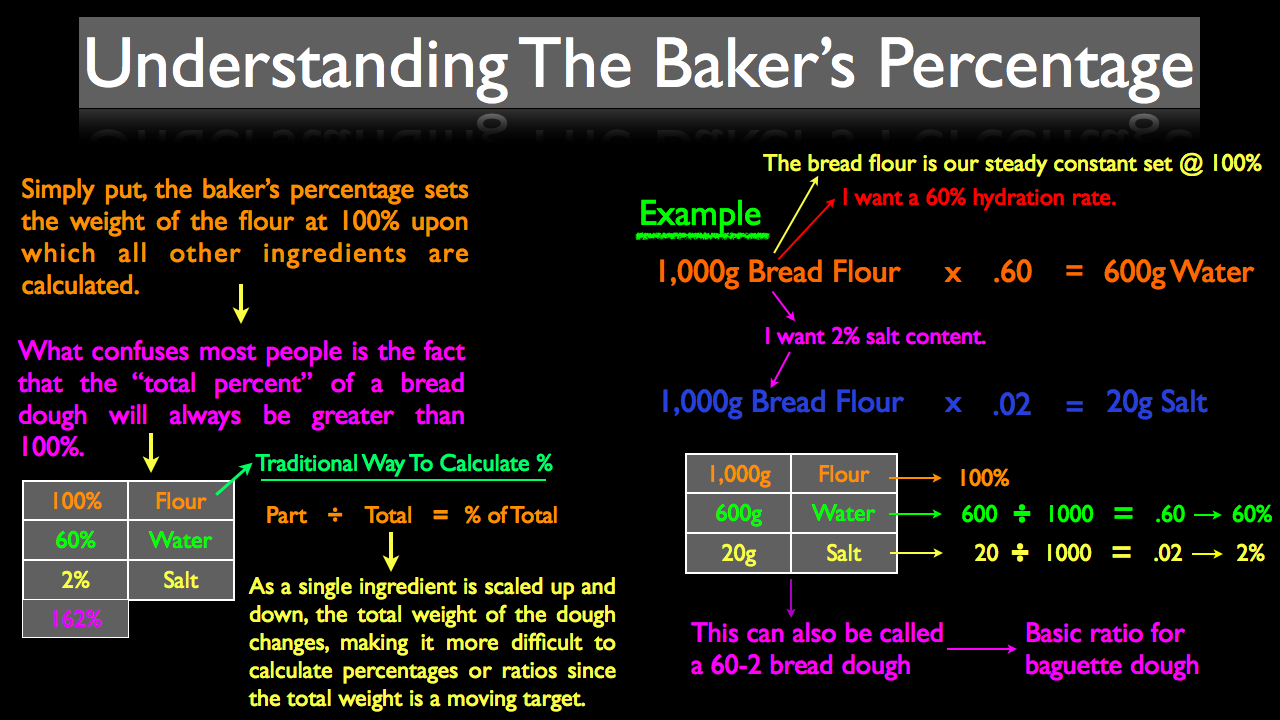
I have always followed the recipe that came with the bread machine. Basically, a measured cup of water, and 450 g of flour. This time I thought I would actually weigh the water in my measured cup. It held 270 g of water. So, applying the hydration equation, you get 270 / 450 = 0.6, or 60% hydration. This is spot on the basic baker's magic formula, and represents the accepted wisdom for a standard loaf.


But as you well know by now, I favour much higher hydration than this, and my experience with this loaf shows why. When we made my "mother-in-law" loaf at the mill, the recipe called for 80% hydration.

Back in the 1980s when I first made the mother-in-law bread, I was using flour from a supermarket somewhere. It was wholemeal, certainly, but probably not "real" in the sense that the Heron Corn Mill and Woodbridge Tide Mill flour is real: not stone ground, characterful, large-bran-flaked wholemeal. In those days, I found it completely impossible to knead the dough. It was simply too wet. So I just squelched it in the bowl for the "15 minutes with the radio" that the recipe calls for.

But this year, using real rustic flour, I was very surprised to find that even at 80% hydration, it was quite possible to knead the bread. The bran in proper stoneground wholemeal flour is capable of absorbing really quite surprising amounts of water.


And this, finally, explains the brick. The flour I used drank up the water I put in my 60% hydration bread machine loaf. It was probably still thirsty. It was certainly still very dry. Like Oliver Twist, it wanted some more. But it never came. All that happened was the bread machine started mixing.

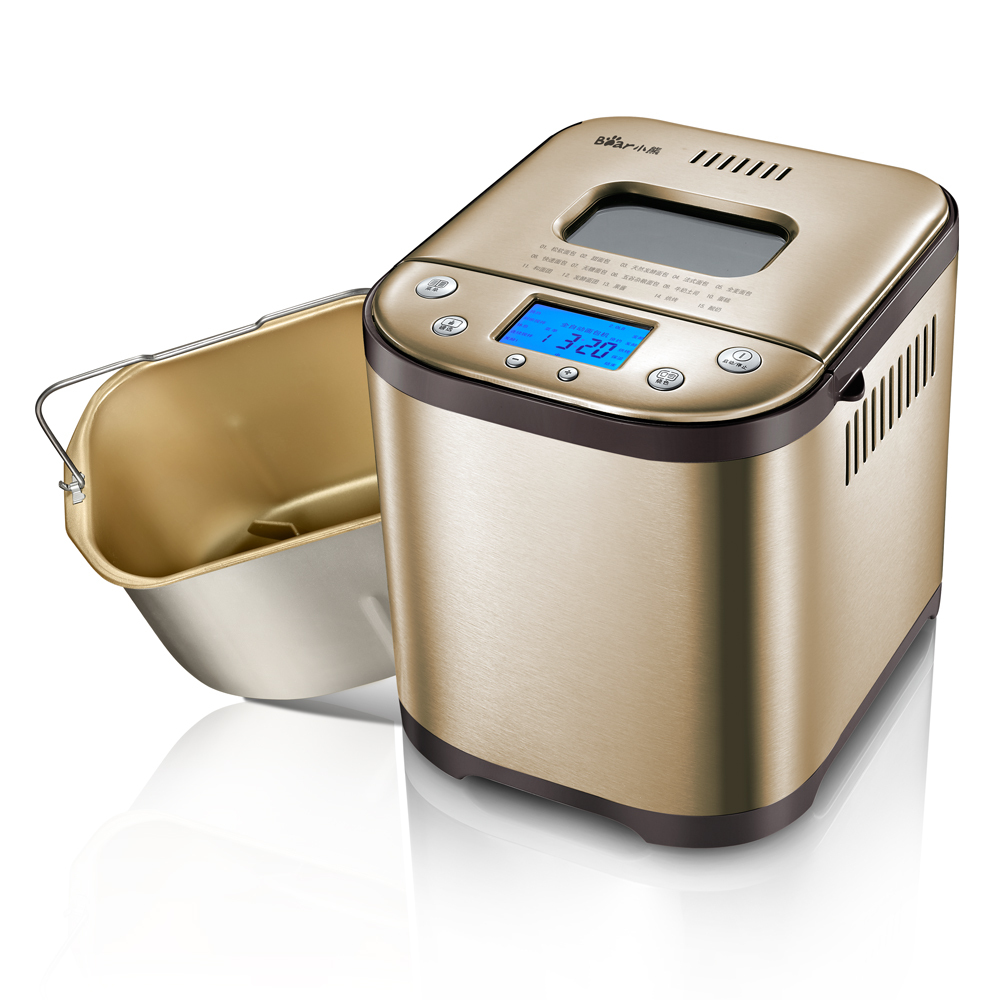
I don't know if you have ever watched a bread machine "kneading" bread. I must be a bit sad, because I find it very interesting how little kneading it actually manages to do. It works on the same principle as the damsel at the mill, only inverted. Whereas the damsel has 4 protruding corners that bash the shoe to send grain into the stone, the bread machine has 2 protruding bumps on the inside of the tin, which the bread bashes as it turns round. In theory some of the dough catches on the bumps, and the paddle keeps turning, stretching the rest of the dough and mixing everything up. You can see one of the bumps at the top of the picture on the left -


In practice, what happens, especially if the dough is too dry, is that the dough just keeps turning and turning, like the picture on the right, and only very occasionally catches on the bumps. Even then it does not catch enough to cause the rest of the dough to be stretched. In fact it just keeps turning the ball of dough round and round on one axis all the time.

So when you have an exceptionally dry piece of dough, as I think my 60% hydrated wholemeal would have been, it gets an extremely small amount of working during the bread machine's kneading phase. That results, as the Woodbridge miller would certainly have realised, in a very poorly developed set of gluten. And poorly developed gluten means poorly risen bread, because it is the stretchy gluten network that traps the gas in the dough. The gas then stretches the gluten again, so you have a virtuous circle. Or you should have. If your dough is not sufficiently hydrated, you get into a vicious circle, where everything conspires to stop the dough rising at all. In short, you get a brick.

I didn't watch the bread machine working this time, because it was running overnight, but when I have watched in the past, I have often added some more water during the kneading phase. It softens the dough, which then gets caught much more easily on the bumps in the tin. And it gets a much better knead from the machine.

No bread machine will ever knead dough like yours truly of course. I am with the Woodbridge miller on this one: get that dough turned out onto a nice work surface in a warm kitchen, and give it a good pummelling. Now that's the way to handle proper stoneground wholemeal flour!

Friday, 30 October 2015

Boon day


Today was a wet and chilly day at Heron Corn Mill. All wrong for the last of the mill's "boon" days this year. The volunteers and staff are supposed to get together for a jolly time sprucing the mill up inside and out, ready for the coming spring or winter, delete as appropriate. In weather like today, it's more a case of "someone has to do it". But appearances, as so often, were deceptive today - and how!


There was a list of jobs, and names of victims - sorry, volunteers - to do them. Audrey's name featured next to "get rid of the mole hills", a job for which I doubt there would have been much competition. My name was ominously next to "pull up Himalayan Balsam". This would have been a high risk activity, because I would just as likely pull up rare orchids, herbs, saplings and maybe even the odd mole as Himalayan Balsam. But it was not to be.


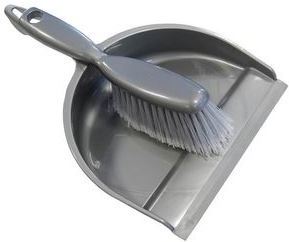
The "B" list of less glamorous (and less dangerous) indoor jobs came to the fore, and I was dispatched to the top floor of the mill with orders to sweep it to within an inch of its life. This is my kind of job. I know one end of a brush from the other, and I can do dust with the best of them. After about half an hour I was in a muck sweat and had to go and get a cuppa. David, the other sweeper, who was manfully sweeping with a mere dustpan and brush, seemed to have more stamina than me, and battled on. "Maybe he'll steal my brush" I thought, giving silent voice to my secret wish.


Fortunately, while imbibing the cup that refresheth and not inebriateth, I was pointed at an uber-brush, the brush of Holy Dream, with an industrial-width brush head. This made the rest of the job much more pleasant.


On the way to the barn for my cuppa, I passed the younger generation of conscripts, who had a nice looking job, namely collecting leaves off the paths. "I could do that" I thought, like Yosser Hughes. "Gizza cuppa and a KitKat, and a job."


So after sweeping out the basement floor, which always attracts leaves and dust beyond what is reasonable, I decided to go native and start muscling in on the leaf collecting concession.


But first, I thought I would check out the fish pass. Rumour had it that recently there was a day, when waters ran high, that the sound of fish had been heard, plopping into the steps of the fish pass. That is undoubtedly the mot juste - plopping.


My luck was in, and I saw a couple of fish making their break for freedom. One flew majestically straight over the water gushing through the middle of the step; one flew sideways to land in the relatively quiet waters at the edge; and one landed atop the side of the step, where little water was flowing over, and had to scriggle over the bare stone, all flap and puff, panic and wild straining. The drama of it!


When I tore myself away, I found the tool shed door open, so I selected a nice heavy rake, and set to work on the lower paths, which were awash with leaves, to mix a metaphor. After a few wheelbarrowfuls of leaves it was time for a hearty lunch in the barn - a duo of soups, a quartet of sandwiches, and a veritable brass band of cakes for afters.


Staggering back to work after lunch, the leaves seemed heavier somehow, and deeper than before. Each load took longer to wheel up to the waste ground. I felt like the frog who jumped half way across the river, then another quarter, then an eighth. Would I ever get to the end? It is the nature of leaves: you can never gather all that fall. So I decided not to beat myself up about it. There was a jolly good compostheapsworth of the pesky blighters to show for my efforts, after all.


So I went in to see how Stuart was getting on with cleaning the millstones. Several of us had gathered to watch him raise the topstone with his lifting gear before lunch - quite a drama in its own right, by the way. And by now the stones were dusted, the left over grain had been collected for some lucky pig or hen somewhere (it can't be ground again, so it goes for animal feed). Buttie had come down from her precarious perch cleaning windows, and was now sweeping up round the Lowder frame. Sweep the unlucky black cat felt the rough edge of Stuart's tongue when he tried to use the Lowder frame as a scratching post. "Oi! Sweep! NOOOOOOOOO!" He's so masterful with those cats.


I got the job of hoovering out the insides of the "furniture" - the covers that contain the flour while it is being ground. This is an important job, as there is nothing mill moth likes better than a bit of flour left in the furniture, so it has to be kept really clean.

After that there was nothing to do but point a couple of passing visitors at the fish pass and advise them not to miss the "greatest show on earth" - jumping fish! I went back down with them, and there was a lot more water than in the morning. Now each step was overflowing right across its width, not just through the lowered part in the middle. And each step looked shallower than before, although the water was certainly flowing much faster.

Whatever it was, the fish seemed to like the conditions in the afternoon, and there was a steady stream of candidates all wanting to take a shot at the great migration stakes. There were dozens and dozens of them even during the 20 minutes or so that I stood and watched. Trout and salmon I recognised from the fish counter at Asda, although they were considerably more lively at the Heron Corn Mill. And from tiddlers of about 6 inches in length, these boys went right up to about 20 inches.

There was no chance of landing on a stone step now, as water was flowing everywhere. But there were as many different techniques as there were fish, it seemed to me. Some did a Fosbury flop, just about clearing the step; some swam up under water all the way; and the larger chaps looked more like poll vaulters, clearing the stones by a good couple of feet, and landing anything up to 5 or 6 feet from where they emerged, like Ursula Andress, from the water.

This was sport of the highest order! Skill, strength, persistence. These fish know no danger, they are all commitment to reaching journey's end. This really is what the TV people call an "incredible journey" and they don't much care who is watching. Fortunately for them, the crowd at the Heron Corn Mill was more interested in cheering them on their way, like Nicholas Parsons.


There were no herons, bears or fishermen amongst those present, just proud mums and dads, failed high jumpers and long distance cyclists. Flag wavers all.

I haven't had so much fun in years! What a boon on a boon day. I commend it to the house!

Monday, 26 October 2015

Are we losing our mojos? Or what?

Here at Bread of Heron, the Heron Corn Mill's community bread group, we are all young at heart. It's the bread making that does it, of course. But there is no escaping the fact that we are occasionally prone to moments of forgetfulness. What time did that bread go in the oven? Is that my bread or yours? You know the kind of thing.

Where's me specs?


This week the shepherd's hut was a bit like a left luggage department. We had a handbag and specs left behind, and even more spectacularly a trayful of bread left in the oven! The specs were kindly dropped off by a passing knight on a white charger. Not at the right house, unfortunately, but it's the thought that counts.

Two people's loaves rose in a way that was not inconsistent with an absence of yeast. Oh yes! Oh no!

Of course it's all my fault. I started the trend last time, with my caraway seed bread with no caraway seeds in it. But where's it all going to end? I think we should be told.

Treading the primrose path of dalliance


Our mission this week was to out-bake the Bake Off and produce the ultimate iced finger buns. I must say that this non-purist baking is starting to get to me. First it was an enriched couronne, with egg, butter and sugar as well as a handful of raisins. Now it's finger rolls with all the above and milk! But I am always prepared to be pleasantly surprised, and this turned out to be one of those occasions.

Here you can see us teetering at the top of the slippery slope towards downright cake-baking. Eggs brazenly rolling round on the worktop.


And sugar! What would Jamie say?


Yet it is somehow attractive, when mixed, that sweet, sticky ball of bun mix.


You can tell which ones are made with proper eggs with golden yolks. 


It's very easy, this recipe. Just cut the dough up into six.


Six, yes.


Ten? The recipe definitely said six!


We all got very Bertinet about weighing our buns out. At this stage (before rolling on the thigh like a Havana cigar) these look just like my mum's "cobs" in their finished state.

There is room for interpretation: fingers may be long and thin, tapered; or short and fat like butcher's sausages. As the baker on the left found, they may keep growing to the size of a club sandwich if they don't hit the oven.

I must say I am puzzled by the rolls on the right. Everyone else saw 6 rolls as 2 * 3, but here we have 4 + 2. Mr Monk on the TV would be wanting to rearrange that tray, for sure.


And then after just 10 minutes in the oven, it's time to take your finger buns out and start not icing them.


That it should come to this! A bread group making iced buns! Even iced buns without the icing.

And then there was maneesh


Here are the maneesh before adorning with their rich, oily, spicy seeded topping -


And here they are in their finished state, and very nice too.


Pinny protocol seems to have broken down here - that looks more like a kangaroo than a heron to me.


This is the way to live! Fresh finger roll filled with cream and stewed apple from the garden. Heaven!


Dusting technique


We have some way to go with the baskets. There is too much shaking and waving around going on! Baskets should be laid on the table and moved with the greatest of care, so as not to dislodge the precious flour that will hopefully stop the dough sticking. You only need to experience a stuck loaf once to learn how important this is!


 Put it down I tell you. It's much easier to control it!


Still, our luck was in, and the slashing seems to be going pretty well. There's a definite knack to the rapid slash - not too heavy, not too slow. This baker went for an ambitious criss cross, and brought it off pretty well, and without deflating the dough, which is a big plus.


Batard shaping


This week we repeated the exercise of practising our shaping and noticing how, if at all, the structure of the "crumb" is affected by folding and stretching at shaping time. 

Batard shaping could become a party game like pin the tail on the donkey, or a village fete sport like welly wanging. My poor batard today was shaped and unshaped half a dozen times before I let it rest in peace.

But this time we weren't just playing at batards: this was serious. We wanted to produce a finished loaf that was recognisably a batard. We used a standard bread recipe, but souped it up a bit as suggested by the recipe from the Larouse bread book, which listed some sourdough sponge in the ingredients. This in effect makes the batard a "pain de campagne". Elizabeth David describes it as similar in a French kind of way to an English bloomer.

Apples galore


As well as Miller's Seedlings from Nell, we've had cookers from Jill and today there was home made apple juice to try. It was rich and thick, and surprisingly dark - not far off a black coffee to look at. But apple to the core - really strong taste, and deliciously appley. And absolutely never never never from concentrate!

Bread in the community


One baker recently picked up an unsold loaf of bread from Arnside's ever popular village shop - Bullough's Londis, which was "free to feed the ducks". But he had a cunning plan. He took it instead to feed the young brains of local school kids. Using a slice of bread to represent a slice through the world, he demonstrated what a small percentage of the world the rocky crust actually is.

Now if that had been a sourdough loaf, the world might have been a different place altogether.

Sourdough news


We're going for it. The next meeting of our Friday group will be on Friday 13th of November. We are going to try the high risk option of making sourdough together. What could possibly go wrong? Watch this space.

My sourdough was spectacularly successful at home this week. I started work on the sponge on Wednesday, used some at the mill on Friday, made sourdough dough on Saturday night and finally baked it on Sunday afternoon. Because the sponge had been fed several times during these 4 days, it was extraordinarily active. This is in effect the "production sourdough" that Andrew Whitley talks of, and it really does make a difference. This is what the dough looked like on Sunday morning, after a 12 hour rise -


And this is the finished product -


And it really does taste good. Let's hope we have something to show on Friday the 13th!