We have been very fortunate at Bread of Heron, the Heron Corn Mill's bread group, in being introduced to our honorary member Bouran, who has enlivened this blog with lots of bread related facts and stories from Palestine, as well as some recipe suggestions.
This summer she visited us at the mill and gave us some hands-on guidance in making flatbreads, and showed us some other favourites from home. This was something of a gala event for us, and was the first time we have been able to get the two halves of the Bread of Heron group baking together. We can't all fit in the shepherd's hut together, so this time we commandeered the barn to prepare our bread, and then did the baking in shifts in the hut.
I believe in fairies
The quietly efficient mill fairies organised the barn in advance, laying out bowls and jugs for us, and arranging a table at the top for Bouran to demonstrate from.
Here's one of them now, look -
I think we were all a bit apprehensive at first, not just because Bouran was coming from a completely different tradition of bread from ours, but also because the recipe called for a full 200 g block of feta. How on earth would that much cheese disappear into what was after all supposed to be a
flat bread?
In Palestine, this bread would be made with a drier, crumblier cheese, but feta is a good approximation to the traditional version.
Pane pan pain ψωμί ekmek brot bröd BREAD
It's worth just pausing to think about that tradition of bread. For most people in the UK, traditional bread undoubtedly means tin baked, highly risen bread, probably sliced and wrapped in plastic. If we're lucky enough to have grown up with real bread, with a proper crust, and enough body to resist the breadknife, it's possible to imagine some sort of continuity reaching back through generations of home bread making, and local bakers making real bread. But the reality is that the history of breadmaking in this country practically came to a full stop after the second world war, with the "invention" of the industrial loaf.
Yet in other european countries, there is a strong and proud tradition of bread. You have only to think of shopping for bread in France or Italy to see what I am talking about.
Even in France you cannot any longer take it for granted that your baguette is the genuine article. Many French bakeries now get their bread delivered, ready to go into the oven. And a lot of what is sold as baguettes is a travesty of the real thing.
And the tradition of communal bakeries, where you either take your own dough to be baked or your own garnishes to add to the baker's own dough, is now practically a thing of the past even in Italy.
Things are certainly improving in this country now, and Bread of Heron is a small part of that change. But there is a very long way to go!
The first thing we learned about Palestinian tradition was that olive oil gets right in there at the start. Whereas we add it as an optional extra after kneading our dough, the Palestinian way is to rub it straight into the dry flour. And the technique is quite different from rubbing butter into flour to make a consistency like bread crumbs. Here it's all about rubbing between the fingers of two hands, as though you are trying to brush the flour off your fingers, rather than between the finger tips. The result is very fine crumbs, and a raised awareness in the baker of the importance of oil in bread.
Oil
Bouran got a bit of a surprise from some of the oil she came across in this country. For her it is important to have extra virgin olive oil. Partly of course this is because Palestine has a tradition of good quality home produced oil, and of consuming it enthusiastically. For me there is a matter of principle involved as well. I just don't like the idea of consuming the oil that is left over after the good stuff has been pressed off. The non-virgin oil has to be separated from the pulp by floating in a bath of chemicals. That's not nice. And the health benefits all seem to be associated directly with extra virgin olive oil, not with olive oil in general.
Thyme is everywhere
I go to a music festival in Huddersfield every year, where the festival slogan is "Music is Everywhere". It's quite a big claim, and it's really quite challenging. If you try believing it, you have to start hearing music where you never realised it was before. The rhythm of the gears in the mill, for instance, or the trickling of water. The birds, the wind, the leaves. It really is an endless proposition.
And Bouran said that for a Palestinian, thyme is like that - it's everywhere, pervading the landscape of ordinary life, to the extent that it becomes so taken for granted that you stop noticing it, unless you think about it. It's everywhere, part of "normal".
Do we have anything in this country to match that? If so it's so ingrained that I can't think what it is.
Bouran's first recipe
First up was a traditional flatbread, laced with thyme and feta cheese.
As we were making this the Brutish way, we had scarcely got started when it was time for a break, out in the sunshine. We got the chance to engage in a typical Palestinian cook's activity - picking the leaves off the thyme. And having a good chat, of course. And a cuppa. We spent about twenty minutes plucking away very busily, as we thought, and proudly brought our egg-cup-fulls of picked leaves for Bouran to inspect. For some reason this seemed to amuse her intensely, and she was roaring with laughter at our pathetic offerings. "If you'd been Palestinian women" she bellowed, tears of laughter streaming down her cheeks, "you would have picked a sackful by now". Well, we did our best, that's all I'm saying! Thyme is a tricky herb. You really can't afford to leave any stems behind, because they are so woody. And stripping from the tip to the base is a bit of a skill in itself.

Just like we worked the oil into the flour, we next worked the thyme into the feta. We really had no idea how small to crumble the feta up, but then we had no real idea how flat the bread we were making was supposed to be. And the feta was going to be inside the bread somehow. It was all a bit of a step into the unknown. What my kids used to call "an ickventure". In fact, it turned out that the finer we crumbled the feta, the easier it would be later to incorporate it into the bread. And working the thyme into the feta not only allowed the flavours to mingle, but saved us the trouble later of spreading the thyme through the bread.
Bouran was quite a canny teacher. She got us to roll our dough out as thin as we could manage. Hers was much thinner than we were likely to manage, and she's clearly a bit of a wizard with the rolling pin. The key to success (to misquote Dylan Thomas) seems to be -
"do ... go gentle into that good night."
Never pressing too hard, she constantly checked where the thickest part of the dough was, and targeted that bit next. Turning the dough often, and keeping aiming at a rectangular shape, there were lots of small actions and adjustments.
Turning the dough was an interesting technique. To avoid the dough catching on the table, she would flip one side over her hand, craftily stretching the dough in the process, and then flick a little flour underneath before repeating with the other side. That way as well as stretching the dough, she kept it moving, and constantly monitored the thickness.
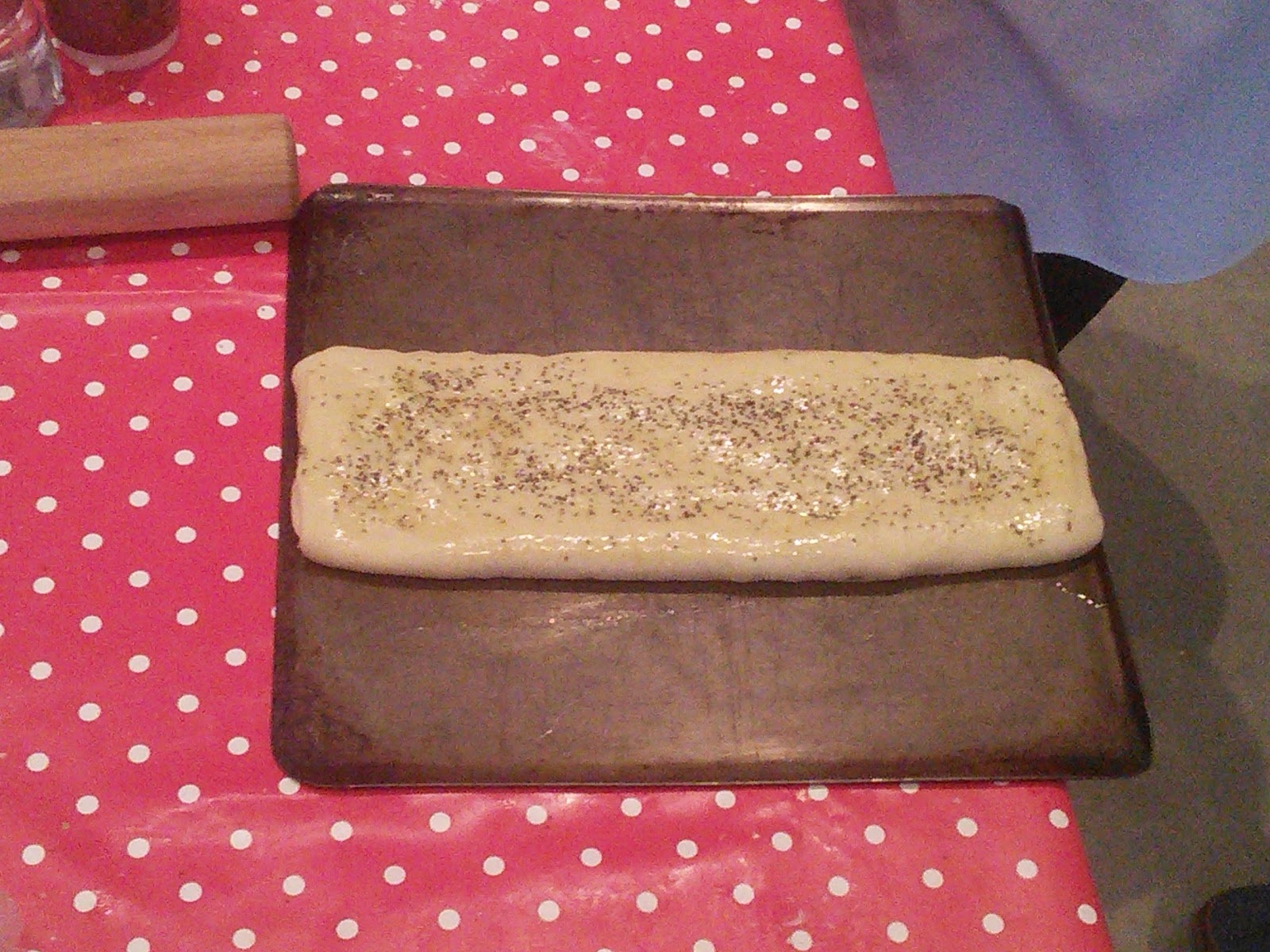
Having achieved a nice wide rectangle of dough, the next stage is to brush the middle third, sprinkle the thyme and feta mixture on top of the oil, and then fold the right third over on top of the sprinkled middle third. Stick the edges together top and bottom by pinching, then brush the folded-over third with more oil and sprinkle the thyme and feta mixture on top of the oil as before. Then fold the left third over the top and pinch all round to seal. Finally brush the top with more oil and sprinkle with some decorative thyme.
Bouran said that at home this would then be rolled flat again, to within a millimetre of its life, but as that was a bit tricky, we should quit while we were winning, advice that we were all too happy to take.
Leftovers
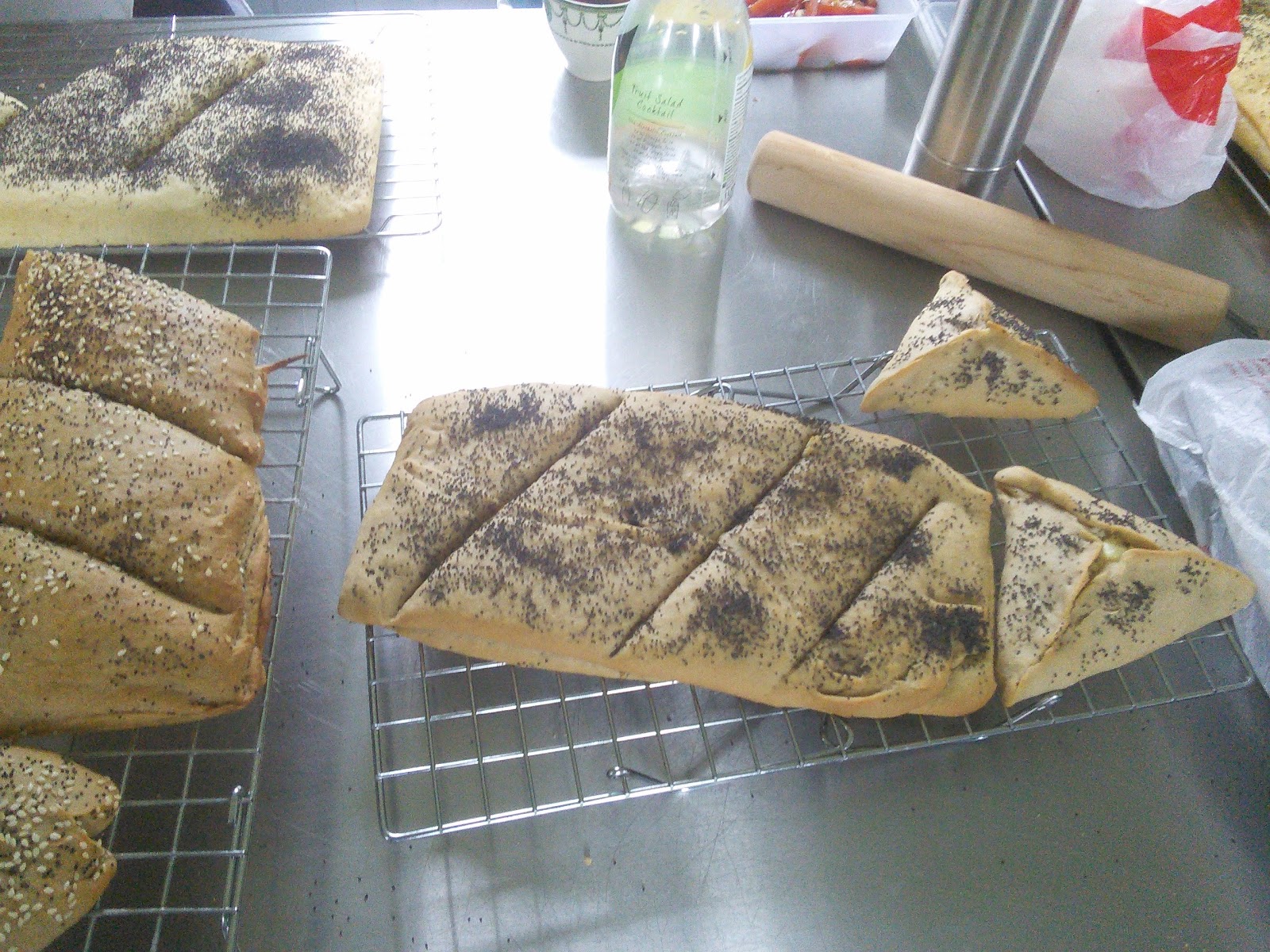
A good cook will always have some left over, and Bouran made sure she had some dough left over to show us some other favourites. These leftover pieces of dough below were all rolled out into circles, and filled with the same feta and thyme mix as the bread -
The two boat shapes on the right were formed by simply lifting up the edge round the filling to form a rim, and pinching the rim together. It's a subtle difference, but simply pinching from the outside of the rim, so that the two inside parts stick together is traditional in one country (can't remember which) and making a fold so that two outside parts are pressed together is traditional in another country. The visual effect is very similar but you can see the difference here, pinched on the left, folded on the right -
The seedy one at the bottom is simply a circle, half covered with filling and folded in half.
The edges are pinched to seal them, and then the whole thing is dipped generously in seeds. I think these were poppy seeds.
The rather effective triangular shape, which Bouran calls a turnover, also starts as a circle, with filling in the middle. If you think of the circle as a clock face, you simply pinch together the edges at 11 o'clock and 1 o'clock; then 10 o'clock and 2 o'clock. As you continue to pinch, you will find you are pinching nearer and nearer the middle of the circle. When you get to the middle, pick up the edge at 6 o'clock on the clock face and pull it into the middle, to join what you have and pinched so far. At this point, it becomes obvious that you have two other seams that need pinching, radiating out from the middle of the clock face towards 4 o'clock and 8 o'clock. Pinch away, and you will soon find you have a tidy triangular parcel.
These were decorated with sesame seeds.
Unfamiliar spices
Bouran's next recipe was quite different. A spicy biscuity cake traditionally served at weddings. There were three surprisingly strong flavours which went into these. The strongest, which developed over time when I kept a few pieces at home, was aniseed. To the western tastebud, this seemed a bit overpowering, but it's a case of what you are used to, I am sure.
Then there was mahlab, the seed of a wild cherry. This is ground up in a mortar and pestle.
This was a very interesting flavour, altogether, and completely new to all of us. We had a good sniff of the precious powder in its little bag.
There was a third spice, which escapes me for the moment. One of the spices made the cake very yellow.
The result was somewhere between a biscuit and a cake, but not at all sweet. We were a little baffled to be honest, but it was certainly a new taste experience for everyone. And I have to say they grew on me as they aged a little at home. What was fascinating was how unfamiliar this taste was to us, yet it was completely familiar to Bouran.
More recognisable as elevenses fodder were these almond topped biscuits, with a full quota of fat and sugar.
Any resemblance to a gingerbread man is purely coincidental. Once baked, they looked very biscuity.
Bouran told me she was amazed by how much sugar we Brits consume, and it was her considered opinion that the way to please the British taste was to put loads of sugar and fat in. Whatever the recipe, sugar and fat was the way to make it popular. Very perceptive, I thought! All that is required then is a cup of tea to wash it down with. Mint tea, of course. There are a surprising number of different kinds of mint in the garden, and they all seem to work quite well as a drink. You can be as careful or as careless as you like - it works fine if you just grab a handful of mint and put it straight in a cup, and pour on some boiling water. Or you can get picky if you like. I'd heard of mint tea being served with lots of sugar, but it is very nice without any. What I wasn't expecting was to find that it is usually added to weak black tea rather than being brewed on its own.

We all then tucked in to our lunches, tasting the breads and turnovers alongside whatever was in our lunchboxes, and talked over the day's baking.
Tip for bloggers
I had a bit of a nightmare with this blog. I was deleting a sentence by repeatedly pressing Ctrl-z to undo a word at a time. All was going fine, but then suddenly everything disappeared, leaving me with a blank blog. This happened to me once before, and all I learned from that experience was that panicking was no help at all. So this time I made sure not to close my Blogger window, and went away to have a think about it. Eventually I realised that Ctrl-z was undoing "things that had happened since I opened the blog" rather than "things I had typed". And the first thing that had happened when I opened the blog was that all the contents were loaded, and I had accidentally undone that and effectively unloaded all my text. So the solution was to do Ctrl-Y to redo the action I had lost, and hey presto the text reappeared. Moral: stay calm and carry on.