Tuesday, 7 April 2015

Memories are made of this

We've now had 3 bread baking sessions at Bread of Heron, the Heron Corn Mill's community bread making group, and we're starting to get to know each other a little bit better. Sometimes we can even remember each other's names. There's a nice atmosphere developing in the shepherd's hut, and not just because the oven is on most  of the time. We had a few laughs together over our first assignment, which was a straightforward tin loaf.

It's tempting to just do what we love and stick to it...


But we are bread pioneers, our mission -

"to explore strange new whirls, to seek out new loaves and new caramelisations,
to boldly dough where no man has scone before."

So we are going to try something a little bit different. Not harder necessarily, or better. Just something to push our envelopes a little.


Something to get us out of our comfort zones.

We did some scones last week, and hot cross buns on Good Friday, both of which were completely new to me, and surprisingly good fun. At home I just make bread, that's all! Coming to bake at the shepherd's hut at the mill is like stepping into a different world...


This week the "Buns" half of the group will be doing rye and raisin bread, and pitta breads on the side. Here are the recipes we are following this week -


I suppose it is inevitable that we will choose some recipes that we fondly remember from childhood, among a haze of warm kitchen smells and apron strings probably. So how about a few memories from childhood?

My mum's cobs


I remember my mum struggling to get her "cob" dough off her fingers, and Stork margarine melting into the dense white doughy delight that we ate straight out of the oven. But not a lot else sticks in the mind in the way of food from back then. It is amazing though that the whole family shares this happy memory of those simple cobs, which were a lot nobblier than these -


It's not always the most sophisticated things that create the most satisfying memories.

Bread and cake shops within sniffing distance


The baker's shop that I remember best from childhood was known for reasons obscured by time as Taylor's, although it was run by Mr Higginbottom. It's been a cafe for 12 years now. This place was famous among the children as somewhere you could buy broken biscuits and penny cakes, all well within the budget of a 3d pocket money. The penny cakes were of course left overs, and became available at the end of the shop day. Occasionally a few were still there the next morning, but we kids knew that the evening was the time to go. Penny cakes came in a paper bag and it was a matter of strict protocol that the bag should not be opened until you were out of the shop. We bought on trust. The bag was often found, on close inspection, to contain not one but several cakes. My favourites were brandy snaps. Who can resist a brandy snap?


Nothing gives children more confidence in the innate goodness of human nature than for an adult to go beyond the call of duty in the business of selling penny cakes.

My memory has been playing tricks on me again. I just realised the baker's name was Ramsbottom, not Higginbottom. But what's in a name? On the other hand I can remember his signature trade mark as if it was yesterday. He used to poke his thumb through the top of his loaves, making what looked like a navel on top of the loaf. Everyone knew where his bread came from.

Other bakers' shops were available. As well as Taylor's, I was regularly to be found further down the road at a shop that made the best vanilla slice in town. It was heavenly. Sweet sticky icing, wobbly bright yellow custard, and the flakiest of flaky pastry. Or so it seems to me now. Who knows really? This one would have been marked down on the pastry, but the custard and icing look about right!


And across the other side of the village, you could get mini Hovis loaves for a very reasonable price - again, well within the parameters dictated by pocket money. The beauty of the mini Hovis was that it was proper wholemeal bread, and quite capable of being sliced to within an inch of its life. I used to see how many slices I could get out of a loaf that was possibly 2 inches long. Perfect with cucumber.


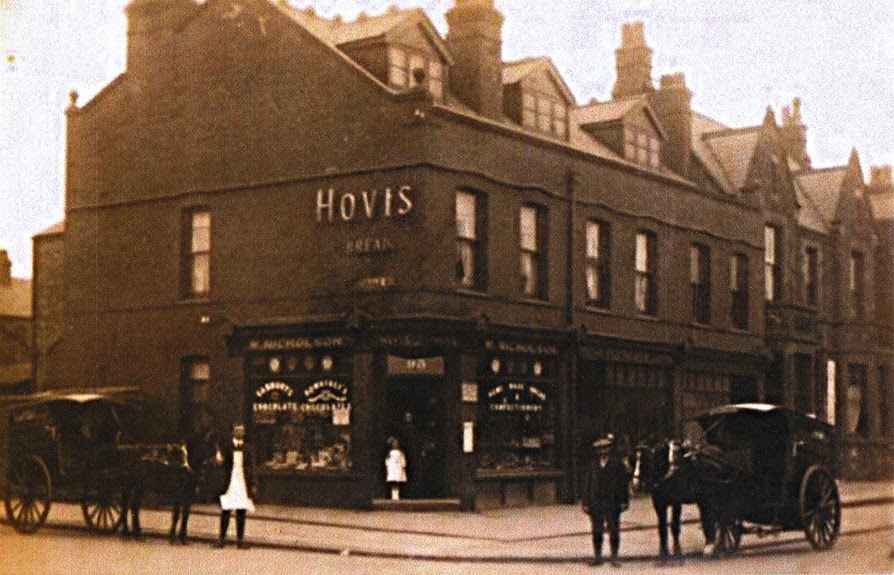
I seem to remember Hovis loaves being sold in waxed yellow wrapping paper, but maybe I'm just inventing that. But shops selling Hovis certainly had signs outside. This is another local bakery, on Beech Road, Chorlton. But it was not "one of mine". Note the Hovis sign on the wall.

Along the road from this bakery there were 3 pubs and 3 chippies. The best of the chippies was the smallest - Wright's Supper Bar, a tiny little place where the queue always started out in the road. Note the "fresh tripe".


Mabs Snack Bar also sold records. We used to have a money box at home where we collected all our 3d bits, until we had enough to buy a single (6/8d each, 3 for £1). We never collected enough to buy an LP at 34/-. If these prices mean nothing to you, don't worry - your turn will come soon enough to be an oldie.

Speculate to accumulate


When I was very young, there were two old ladies in our road who, like Mr Ramsbottom, regularly reinforced my childish faith in the essential goodness of human beings. I used to give them a 4 oz box of chocolates for Christmas -


and they used to give me an 8 oz box back. Now there's psychology for you!

Unreliable witness


This memory is a slippery creature, without a doubt. We all think we have clear memories from long ago, but how accurate these memories really are is very open to doubt, given how very unreliable our shorter term memories are.


And medium term memories are no better. I have been complaining for several years about a block of flats in Manchester that (according to me) were built across one of two derelict railway lines, making it impossible to reopen the line properly. Yet when I had a look recently, both lines were still there, as shown in this picture when the metro was being built -


It makes me wonder, what kind of a witness would I be? And how reliable is any eye witness years, months, weeks, days, hours or even minutes after the event? There's nothing new here, of course. People have been misremembering things for centuries. Here is Hamlet's famous soliloquy as mangled by the jobbing actor who was responsible for the First Quarto. He starts to ramble after 6 words!

To be, or not to be, eye there's the point,
To Die, to sleep, is that all? Aye all:
No, to sleep, to dream, aye marry there it goes,
For in that dream of death, when we awake,
And borne before an everlasting Judge,
From whence no passenger ever returned,
The undiscovered country, at whose sight
The happy smile, and the accursed damn'd.
But for this, the joyful hope of this,
Who'd bear the scorns and flattery of the world,
Scorned by the right rich, the rich cursed of the poor?
The widow being oppressed, the orphan wrong'd,
The taste of hunger, or a tyrants reign,
And thousand more calamities besides,
To grunt and sweat under this weary life,
When that he may his full Quietus make,
With a bare bodkin, who would this endure,
But for a hope of something after death?
Which puzzles the brain, and doth confound the sense,
Which makes us rather bear those evils we have,
Than fly to others that we know not of.
Aye that, O this conscience makes cowards of us all,
Lady in thy orizons, be all my sins remembered


Fudging the issue


I find I need some sort of a system in the kitchen. Maybe for "the kitchen" read "life". If I have to put flour, yeast, salt and seeds into a bowl, the slightest distraction is enough to wipe my memory completely, and I can find myself wondering if I put the salt and the yeast in, or was it just the salt? Or just the yeast? Nell has a good trick, which is to distribute all the bits around different parts of the bowl, so it is clear what is in and what is not.

Likewise when did I put the bread in the oven? Was it "5 to" or "5 past"? I can easily find myself with no idea how long the bread has been in. On the other hand, I am surprisingly good at getting up to check the clock at just about the right time - when the bread needs turning, or taking out. So maybe inside every temporally challenged man there is a time and motion expert trying to get out. But I don't think so.

At least I am not alone in this constant struggle with memory. We made a couple of batches of hot cross buns at the mill on Good Friday. The first batch needed to be "crossed" when we were part way through preparing the second batch. So we stopped working on the second batch before adding the water, and came back to them when we'd dealt with the first batch. The three of us all agreed we were up to the point of adding the water, and it was only some time later that we realised we had all forgotten to add the sugar. Unlike my scones last week, this was a salvageable mistake, and we simply worked the sugar in. Ah, the happy ending!

The loneliness of the long distance flour bagger


A few weeks ago I had a trip out with Stuart the miller to deliver some spelt to a customer. Getting the 20 kg of spelt bagged up in a nice new sack was my job - just about my level in some ways, and a surprisingly soothing activity for the brain. A lot of the music I listen to is slow and repetitive. There's obviously something about this kind of activity that suits my brain!

What really surprised me was how hard it was to keep track of where I was up to, while carrying out a mundane and repetitive task. Try listening to this for about a minute, and see if you can remember how it started.

There are a number of weighing scales at the mill, but the heavy duty ones are a bit of a puzzle to use, and we are not entirely sure all the bits are present and correct. So weighing a relatively small amount of flour on a large set of scales would be a bit too error prone to be attempted with confidence. There is a smaller set of scales which are fine for bagging up flour in 600 g and 1.5 kg bags, so I opted to use these to weigh out my 20 kg.


500 g of flour is pretty well all the scoop can hold, so 20 kg is forty scoops' worth. Hmmm. Surely it can't be that hard to count up to 40 ... can it? After two scoops I decided discretion was the better part of valour. Rather than find myself all at sea with half a sack of flour weighed out...


I thought I'd better start keeping a record. Not having my worry beans with me, I decided to start taking notes. I started off confidently enough, my plan being to make a note every time I had weighed out one kg. Weigh one scoop, do nothing; weigh one scoop, write it down; weigh one scoop, do nothing; weigh one scoop, write it down. What could possibly go wrong?

Frailty thy name is memory


When I got to the third scoop, I blinked. Was this the third or the fourth? It was Groundhog Day all over. I decided it was the third, and went ahead and weighed the fourth. But then the rot set in. Not to mention the panic. Eventually I weighed the sack! 2.4 kg. So what did that mean? Four scoops with lots of experimental error? Or was I really on to five scoops already, but wildly under-weighing? At this point the cold sweat started. Should I empty the sack and start again? Did I have a choice? Then I had a brainwave: weigh an empty sack! It tipped the scales at 300g, so I concluded that I had done four scoops and been a bit generous. Nobody likes a short pint.

In the end I decided there was really no alternative to recording every scoop as I weighed it. I who have a brain the size of a house, effectively ready reckoning on an abacus! Still, better safe than sorry. Just a bit of a wake up call, that's all!

When we delivered the flour to our customer, I found myself rather envious of this scale in pride of place on the window sill. This baby has a full set of imperial weights, and a rather charming needle in between the two pans to indicate the balance.


 Anybody got any interesting scales at home? And if you are baking the rye and raisin loaf this Friday, don't forget to soak your raisins on Thursday!

Monday, 30 March 2015

Pass the salt

This week's task at the Bread of Heron, the community bread group at the Heron Corn Mill, was to bake a seeded loaf choosing freely from a range of seeds and other texture enhancers.

Nell had provided a straightforward seeded loaf recipe which included molasses, butter and seeds. We could choose from our own Heron Corn Mill spelt and a range of commercial flours. The recipe suggested a couple of ounces of seeds, but we were free to choose from sunflower, pumpkin, sesame, linseed; and there was cracked wheat and rye flakes on hand as well. Everything in fact, to produce a rich and interesting loaf, with any level of crunch according to the preference of the baker.

Predictably, within these broad parameters, we produced a wide range of loaves in highly individual styles . The temptation to tweak a recipe is very hard to resist.


Such freedom is only possible in a community bread making group, of course. Can you just see us on MasterChef? "So Pete, you've chosen a mixture of banana seeds and giant Hibiscus. How do you think that's going to work?"
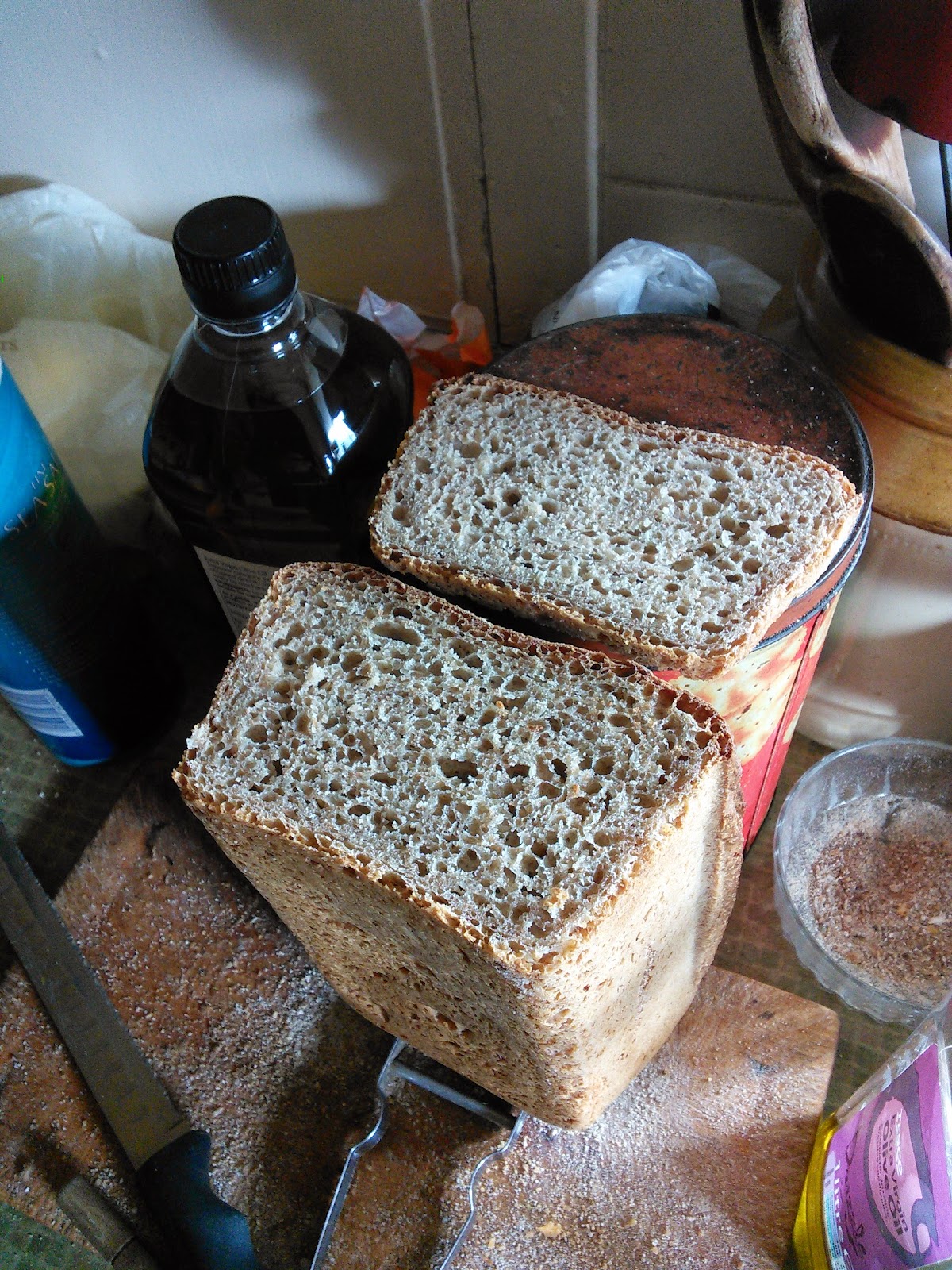

Amazingly, we all seemed to come out unscathed again today! How did that happen?

Plan A was to dissolve the molasses and butter in warm water, and add the lot to the dry ingredients in the mixing bowl. There might have been one good Christian soul who followed this procedure, but generally the dough assembly line was every man and woman for themselves. One might as well try to herd cats. Butter was squelched through fingers, salt was mixed with water, molasses were stirred into flour. You name it.


And yet, such is the glorious alchemy of baking, after five minutes of anarchy and chaos, everyone had a perfectly presentable bowl of dough to turn out onto the shiny new stainless steel tables in the shepherd's hut. That's not to say there weren't some tell-tale signs of sticky fingers as well -


And as for me and the salt. Well! Try as I might, I couldn't get any salt out of the salt drum. You know how it is - the merest bit of moisture and the whole thing seizes up like a brick. So I thought I'd give it a good shake to break the lumps up. Bad move.

There are moments in everyone's life which scar them. Character forming moments that stay with you for ever. Such a moment happened in 1965 at Mrs Cattle's Guest House, Wiveliscombe. (Peace be with her.) My innocent brother picked up the tomato sauce bottle and, following the instructions printed thereon, gave it a vigorous shake. It probably seemed like a good idea at the time, but events proved otherwise. Events, dear boy, events!

Persons who do not screw the tops on bottles before returning them to circulation on communal tables in guest houses deserve to be treated with disdain, or possibly to be horsewhipped to within an inch of their lives, you choose. In my brother's case, there was tomato sauce everywhere - ceiling, tablecloth, fellow guests. It looked like something from Reservoir Dogs.

With that traumatic event still vividly in mind, and holding stoutly onto the top of the salt drum, I shook. And the bottom fell out of the salt market.


Oops.


I just wanted to slink away stage left.


Unsurprisingly, perhaps, this business of salt is troubling me this week, and was one topic that we discussed at the shepherd's hut at coffee time.


If you use a bread making machine, you will have read the dire injunctions in the instruction book warning you to keep the salt away from the yeast. My instruction book never actually explained why, but the simple fact is that if you mix them together, the salt turns the yeast to gloop, which is never a good thing.


Our recipe suggested salt to one side of the flour, yeast to the other, then mix everything together with the wet ingredients. But there's always the option to mix the salt through the flour beforehand. That way the most salt the yeast is likely to come into contact with is a grain or two. And last week's technique of mixing the yeast into the water also reduces the risk of a stand off between salt and yeast. My preferred option is to mix the salt with the water, and stir quick action dry yeast into the flour. That pretty well guarantees an even distribution of the salt round the dough.

So why do we put salt in bread at all if the yeast doesn't like it? Certainly it affects the taste. It also affects the taste buds, so if you are used to plenty of salt in your diet (not a good thing from a health point of view) then your taste buds will register it less and less over time. Much the same thing applies to monosodium glutamate, and most people seem to have decided it's not a great idea to get too used to everything having its flavour "enhanced" by MSG.


Apart from contributing to the flavour and regulating the action of the yeast, salt apparently also helps the development of the gluten in the dough. This article describes the role of salt, but you might want to take it "cum grano salis" when you see the recommendation of 2% salt to flour. That's two teaspoons to one loaf, whereas we were all quite satisfied with half that amount.


There's a great little trattoria called Il Contadino in Florence where we went (every day) on holiday. I watched a couple eating there one day. She hit everything with the salt cellar; and he put about half a bottle of olive oil on a plate of spinach! I think I'm with him on that one. [Don't get him started on olive oil. Ed.]


The recipe suggested we could get away with a single rise. This raises the question why bother with a second rise, but I think I'll leave that hot potato for another day. At any rate it meant that we could afford to let our dough take its own good time to rise. So we left it on the shelf under the table as opposed to putting it near the warm oven. This actually turned out to be quite an interesting experiment, because some of the dough was standing in direct sunlight, and rose significantly more vigorously than the dough that was in the shade. So there is definitely some room for influencing the dough at this stage, although the accepted wisdom seems to be that a slower rise allows the yeast to do its thing better.

With an extended rise for our bread, we had enough time to make some scones. And I'm going to nail my colours to the mast right now: scone rhymes with bone, not gone. Or possibly if you're Scottish I might allow spoon.


Some of us did cheese scones (bone! bone!) and some did fruity ones. I did some speciality flat ones, because I replaced "flour SR" in the recipe by "flour not SR" and didn't compensate by adding baking powder. This was my first ever attempt at the mighty scone, and it was truly a baptism of fire among so many experienced sconites. Still, I don't think I am likely to make that particular mistake again.


See if you can spot the point at which my flat scones joined the others on the cooling racks. It's really not that hard!


We all had a jolly good tuck in, with jam and cream or cheese as appropriate, which had been kindly brought along by a group member.


There are a couple of areas where I think we have room for improvement. We haven't quite got into the habit of writing down when our bread is due out; and we don't always shut the oven door to keep the heat in.

Still, all the bread came out looking and smelling great. And perhaps surprisingly the dough which seemed the driest when it went in the tin eventually rose the best.


So do we really believe the saying that wetter better? A softer dough certainly makes kneading less like hard work. But should a wetter dough be producing more carbon dioxide during the rising process? Should it be producing more steam inside the bread as it bakes? On this occasion, something else happened, because the driest dough rose most. Maybe there are just more variables that I haven't worked out yet.


Nice loaves all round, anyway. And we had a good tasting session - always a nice end to a bake-up. The various seeds produced interesting results, both inside and on top of our loaves. And for me the best bit is that my missus has changed her mind after 30 years of not liking caraway seeds, and has been monopolising my caraway loaf since I took it home.


Now that really is a result!


Friday, 20 March 2015

Bread of Heron Spelt challenge

Greetings from the Bread of Heron community bread group at the Heron Corn Mill! Today was special for three reasons: -

There was a total eclipse of the sun
It was the centenary of the birth of Sviatoslav Richter
The second batch of Bread of Heron bread was baked.


I leave it to you to decide which is the most significant of these events.

Like last week, when the first group of intrepid bread makers baked in the sparkling new shepherd's hut at the Heron Corn Mill, spelt was on the menu today for the second group. Along with Heron Corn Mill wholemeal spelt, there was white spelt from Dove's. We all followed the same recipe, but varied the flour, some choosing wholemeal, some white and some mixing the two in various proportions.

The oven in the shepherd's hut is fan assisted, and seems to me to be working very efficiently. Mind you, I'm comparing it to a quite elderly gas oven at home, which seems better at heating the kitchen than baking bread. It's certainly cosy in the shepherd's hut, but the oven's first priority is definitely cooking our bread.

It's really surprising how differently two bowls of flour can behave when it comes to soaking up water.


We all had 1 lb of spelt flour, and we all started out with 12 fl oz of water. Admittedly the flour ranged from 100% wholemeal to 100% white, but it was all spelt. Yet the consistency of everyone's dough was markedly different.

Last week I used all my 12 fl oz of water with my wholemeal flour, and was very happy with a soft, workable dough. Today's wholemeal bakers found much the same. This week I was using half and half white and wholemeal spelt, so I started out with about 10-11 fl oz of water, to see how I got on. I was really surprised to find that my dough was impossibly sloppy, even though I'd used significantly less water than last week. It's very unusual for me to decide I've got too much water, but I certainly felt that today, and I twice went back for more wholemeal flour before I got anywhere near an acceptable consistency, and a workable dough.  And that last bit of water never got used up.

Usually all the bits of dough eventually detach themselves as I knead, and I finish up with nice clean hands. Not today though: my hands were still distinctly claggy when the dough was thoroughly kneaded.


I found this very surprising, and I will be having a go with white spelt again soon, to see if I can get the measure of it. Dove's white spelt is perfectly good flour, and I am intrigued that it seems to have behaved so very differently on this occasion from the Heron's own wholemeal spelt. Is there a knack I need to acquire?

Once you've kneaded your dough, there is nothing to do but sit down and have a chat over a nice cup o' tea.


Today the talk was all about food, much of it related to pigs. Pigs' trotters and cabbage for breakfast; making black pudding; keeping a pig (not just for Christmas); letting pigs free range to produce muscle; muscle producing flavoursome meat.

Hmm. I think I put a bit too much water in this dough.

All this reminded me of Lambert the pig slaughterer - a character in the second part of Samuel Beckett's Trilogy.

Samuel Beckett

"Big Lambert had not a tooth in his head and smoked his cigarettes in a cigarette-holder, while regretting his pipe. He was highly thought of as a bleeder and disjointer of pigs and greatly sought after, I exaggerate, in that capacity. For his fee was lower than the butcher's, and he had even been known to demand no more, in return for his services, than a lump of gammon or a pig's cheek. How plausible all that is. He often spoke of his father with respect and tenderness. His like will not be seen again, he used to say, once I am gone...

And to return to our pigs, Lambert continued to expatiate, to his near and dear ones, of an evening, while the lamp burned low, on the specimen he had just slaughtered, until the day he was summoned to slaughter another. Then all his conversation was of this new pig, so unlike the other in every respect, so quite unlike, and yet at bottom the same. For all pigs are alike, when you get to know their little ways, struggle, squeal, bleed, squeal, struggle, bleed, squeal and faint away, in more or less the same way exactly, a way that is all their own and could never be imitated by a lamb, for example, or a kid."

And to return to our bread... each new loaf so unlike the other in every respect, so quite unlike, and yet at bottom the same.

I learned a couple of good tips today, which is another good reason for coming to the bread group. How can you tell when your dough is sufficiently developed, and you can decently stop slogging away at the kneading? If you stretch your dough between the finger and thumb of each hand, and keep stretching, it will eventually tear, but well kneaded dough, with its stretchy gluten, will stretch amazingly thin, a bit like bubble gum, and you should be able to see the light through the dough.


A very good party trick, though with my troublesome dough today I thought I'd keep that one to try out at home!

When you have got your dough in the tin (or basket) and you want to let it rise again, it's a good idea to put it in a plastic bag to create a cosy micro climate for it, like a poly-tunnel for bread. But how can you stop it touching the bag when it rises? Blow into the bag please sir. Remember goldfish at the fair? They always used to half fill the bag with water and then blow it up with air. There's no way the dough will touch the top of a fully inflated bag. Just don't try it with a bag with holes in or you'll be there all day.


When the bread came out of the oven, there was the usual ceremony of tapping the bottoms to see if it sounded hollow.


I am coming to the conclusion that "sounding hollow" is very much a matter of interpretation. "Quot homines, tot sententiae" as my Latin teacher used to say. Maybe it's just me, but I always seem to want to give mine a bit longer in the oven, and I want my hollow sound to be like tapping on a wooden box, not tapping on a cardboard box.

Whatever the rights and wrongs, if any, everybody's bread looked fine when cut, and all our loaves had good texture, more or less open as you would expect when comparing wholemeal to lighter flours.


And tasting was a complete delight again this week. I think if any of us had bought any of these loaves in a bread shop, we would have been more than happy with the flavour, and that for me is what it is all about.


I personally think that the Heron wholemeal spelt is a winner, producing a very satisfying loaf, with a really delicious nutty flavour. A nice thing about spelt generally is that you can be really clumsy when shaping the loaves - I certainly am - and because the dough settles and spreads as well as rising, even the roughest loaf will morph into a beautiful smooth beast by the time it is ready to go in the oven. Mine today looked like a croissant when I had shaped it, but it was perfectly "normal" when it went in the oven, and looked like this when I got it home -


This shows that you don't have to mess the dough around too much in the hope of making it look right at shaping time - just give it a gentle stretch and fold and put it in the tin. Less is more.

My loaf has a nice open texture, but for me it's lacking a bit of body compared to the wholemeal last week. Maybe when it's had a day or so to firm up it'll develop that lovely sponginess that I really like.

Last week I promised an answer to this question out of Ulysses -

"Tell me where is fancy bread? At Rourke's the baker's it is said."

If you start by saying this is a crossword clue, then "it is said" means the clue contains something that can be spelled two way, each meaning something different. Then if you change the spelling of "bread" to "bred", you get the song from the casket scene (Act 3 Scene 2) in Shakespeare's Merchant of Venice -


Here Musicke. A Song the whilst Bassanio comments on the Caskets to himselfe.

Tell me where is fancie bred,
Or in the heart, or in the head:
How begot, how nourished.
    Replie, replie.

It is engendred in the eyes,
With gazing fed, and Fancie dies,
In the cradle where it lies:
Let vs all ring Fancies knell.
Ile begin it. Ding, dong, bell

All.
    Ding, dong, bell

All that glisters is not gold, perhaps, but our wholemeal, mixed and white spelt loaves were all worthy of a medal today.

Happy baking y'all.